
While swimmers and boaters don’t have to fear sharks or giant squid in the Great Lakes watershed, invasive fish the size of large dogs lurk in the freshwater. Invasive carp have wreaked havoc on the ecosystem for over a century, but officials have hit a milestone worth celebrating in the fight against these mega fish.
In the past 15 years, wildlife officials have removed 50 million pounds of invasive carp from the Illinois River. That’s equivalent to roughly 5,000 elephants. The removal is part of a broader and coordinated effort to protect the rivers and lakes from this non native species.
Why are carp a problem?
Currently, four species of invasive carp cause harm in the Great Lakes and beyond—bighead carp (Hypophthalmichthys nobilis), silver carp (Hypophthalmichthys molitrix), black carp (Mylopharyngodon piceus), and grass carp (Ctenopharyngodon idella).
According to the Great Lakes Fishery Commission, all four species were imported to North America to help with pest control in aquaculture facilities in the 1970s. The carp escaped confinement in only 10 years, and have spread to the Mississippi River basin and other large rivers, including the Missouri and Illinois.
Each of the four invasive carp species can weigh more than 100 pounds and grow to four feet from tip to tail. Bighead carp and silver carp generally feed on the tiny plankton in the water, while grass carp eats rooted plants in shallow water, and black carp feed primarily on mollusks and snails.
“They consume so much food and can exist in such great numbers that they can really reduce the amount of [resources] for resident species of fish,” Peter Alsip, an ecologist with the NOAA Great Lakes Environmental Research Lab told Popular Science in 2024. “They can have indirect effects on the whole ecosystem because [silver carp] are consuming phytoplankton and zooplankton, which are essentially the base of the food web.”
Once inside a watershed, they can reproduce rapidly and compete with native fish species for resources. In areas where invasive carp are abundant, they have harmed other fish species and interfered with commercial and recreational fishing, according to the United States Fish & Wildlife Service (USFWS). They can also pose a danger to humans, as the giant fish can jump out of the lake and hit unsuspecting boaters.
What is being done to stop them?
Carp eradication measures have been active for over 100 years. These efforts include targeted mass removal efforts, developing barriers to block or impede their movement, and ongoing monitoring.
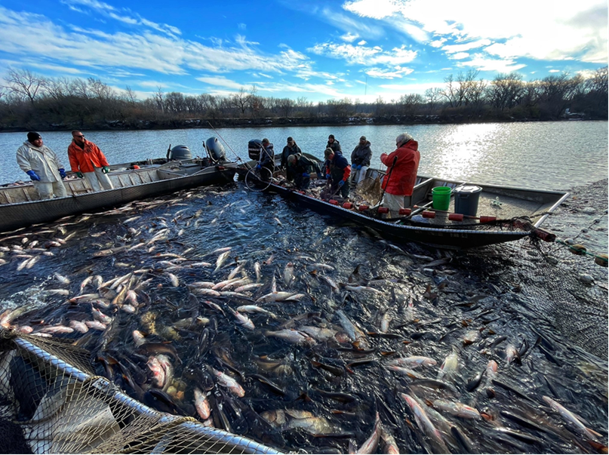
The 50 million pounds of fish removed from the Illinois River were part of a program focusing on the northern part of the river about 50 miles from Lake Michigan. The removal project is designed to suppress the mostly adult populations of carp living in the area, by limiting their ability to reproduce and reduce their migration upstream towards the Electric Dispersal Barrier System. Located about 37 miles from Lake Michigan, this electric barrier is designed to deter their movement through the Chicago area. It is one of the main tools wildlife officials are using to keep them from further entering the Great Lakes through the Illinois River. Another program in the Illinois River offers fish harvest incentives to commercial fishers in the river’s lower 240 miles.
“The more invasive carp we remove, the more we reduce their harmful impacts and the risk of them reaching Lake Michigan,” the USFWS wrote on Facebook. “Thanks to these and other efforts to monitor our waters and prevent the spread of invasive carp, Illinois and more than two dozen partners are safeguarding some of our most prized native fisheries, and the Great Lakes regional economy.”
The post 50 million pounds of invasive fish removed from Illinois River appeared first on Popular Science.
from Popular Science https://ift.tt/3dFQ6Le



0 Comments