
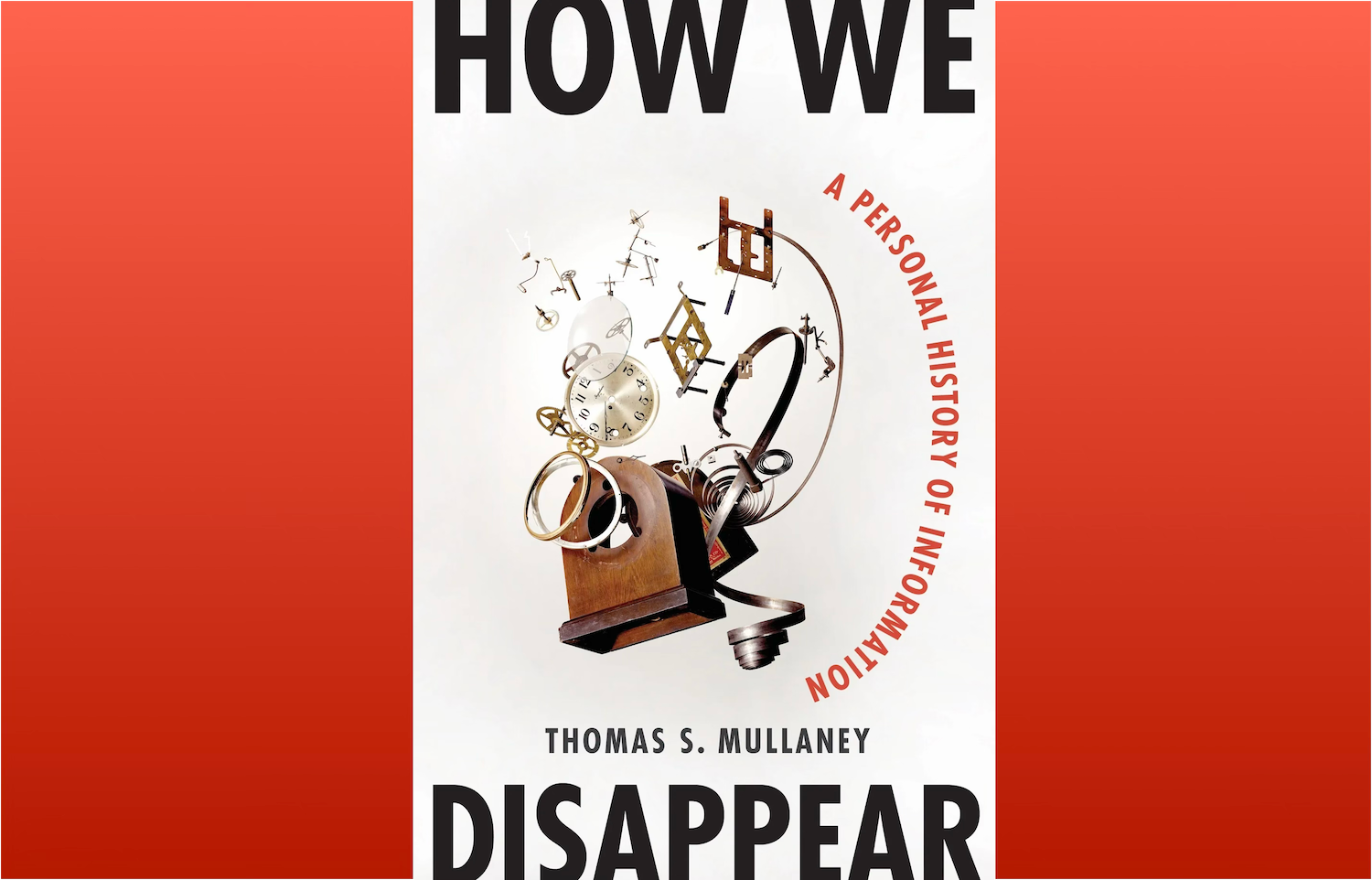
Excerpted from How We Disappear: A Personal History of Information by Thomas S. Mullaney with permission of W. W. Norton & Company, Inc. All rights reserved. Copyright © 2026 by Thomas S. Mullaney.
What is information?
It’s a word we’ve become inured to—and unimaginative about. “How much information,” we ask, “can this hard drive store?” Or “The average person has more information at her fingertips than ever before,” we remark. Information, it would seem, is some kind of ethereal fluid, quantifiable like water or gasoline.
Narrower still is our use of the term information technology. This phrase summons to mind devices and machines: laptops, flatscreen TVs, QR codes, ChatGPT. Sleek things. For history lovers, perhaps our picture expands to include the book, telegraphy, braille, radio, and other IT systems from the pre-computing era. Either way, an information technology is some kind of object, tool, or machine, and information is the liquid-like stuff it channels, stores, retrieves, or produces.
This clinical understanding of information derives in large part from the work of Claude Shannon, the brilliant mathematician often called the father of the modern information age. In The Mathematical Theory of Communication, his groundbreaking 1948 work, Shannon defined information with breathtaking precision and elegance. Information was something transmitted: a message sent from a source to a destination over a channel. Full stop. Shannon’s information was indifferent to semantic meaning—it could be anything from a string of random digits to a love letter. The core question pertained to “the reliable transmission of messages through noisy communication channels.”
Shannon is perhaps best known for introducing the concept of entropy into information science, transplanting it from physics as a way of quantifying information. Specifically, Shannon’s goal was to quantify the uncertainty of any given message. He asked: how many binary, yes-or-no questions would it take to determine the contents of a given message, with each symbol in that message being represented by a coin flip? The more unpredictable a message, the more guesses it required, and thus the costlier it was from the standpoint of a communications system.
Consider two five-character sequences, the first being random, and the second being a common English word: “XQZJP” and “LIGHT.” Now imagine trying to deduce the content of these messages through a series of fifty-fifty brute-force guesses. Since the first sequence is a random assortment of letters, each character has an equal chance of being any of twenty-six letters in the English alphabet. With a binary, coin-flip question splitting the total number of possibilities by half each time, it would take an average of 4.7 coin flips to figure out each individual letter—or an average of 23.5 to figure out the entire message. For Shannon, “XQZJP” is high entropy because it’s high in uncertainty.
As devotees of daily Wordle puzzles know well, however, the word light is not random. It obeys certain kinds of statistical irregularities of the English language. When the letter l is found at the beginning of a word, for example, it is far more likely for the next letter to be an i. rather than a b or an x. On account of the relative predictability of English, it takes on average only 1.5 coin flips to determine any given symbol, or just 7.5 yes/no questions to figure out the word “LIGHT”—far fewer than the 23.5 required for the random string. “LIGHT” is low entropy, because it’s low in uncertainty.
It’s impossible to exaggerate Shannon’s impact on our contemporary world. By reducing the concept of information to an abstract, quantifiable measurement—what he termed entropy, or the measurement of uncertainty—engineers could at long last approach the core elements of modern telecommunications— encryption, transmission, error correction, compression, and more—as a formal science built atop the foundations of mathematical certainty. By today, every compressed file, every streamed video, and every encrypted message relies on Shannon entropy to ensure that information is transmitted as efficiently and reliably as possible, minimizing wasted space while ensuring the arrival of the message intact. His work laid the foundation for the digital age.
There was a conceptual cost to Shannon’s precision and sterility, however—a cutting-room floor littered with the deleted scenes of information technology history. Simply put, information technologies aren’t sleek or clean—and they never have been. They’re viscous, messy, and strange.
Let’s play a guessing game. I’ll describe one thing or another, and you try to figure out what it might be.
“Rag-and-Bone Men” scour an early modern European town in search of the foulest of prey: dirty underwear. Heaping the grime-encrusted linens on their carts, they slog them to one of the many riverside workshops that dot the landscape. They’re tossed into noxious vats of oatmeal-like sludge and allowed to ferment. The grease, the feces, the urea, and fiber steep for days, workers shredding the sludge with razor-sharp knives. After a while, another team pours this creamy filth into rectangular frames, crisscrossed with wire filaments, pressing out the excess liquid, and adding the rendered fat of animals.
We know this as paper.
Woodsmen slog through a dense jungle thicket, hatchets sharpened and at the ready to bring goliaths to their knees: hulking, eighty-foot trees, their trunks as wide as grown men. Collapsing to the ground, millions upon millions of these giants will have their arteries opened by ax-blow, bleeding out a tiny quantum of gummy blood on the forest floor: gutta percha, it was called in Malay, a natural bioplastic. This is the woodsman’s bounty—he will get paid today. Half a world away, vats of forest blood are crowbarred open by factory workers, who slosh it up and down the surface of thick, braided, veinous metal cords, long nervous cables that will be coiled into immense spools, loaded onto colossal oceangoing ships, and laid like hemispheric extension cords across the pitch-black, underwater face of the planet. Filament by filament, this vast, diaphanous, bathymetric web will soon pulse with electricity, carrying messages between generals, stockbrokers, newspapermen, and lovers, all at a speed just shy of light.
We know this as telegraphy.
A family of four gathers around a small, rapidly-vibrating sliver of crystal, one whose job is to snatch a particular voice or song from the ether, plucking it from a cacophonous sea of otherwise inaudible sounds. The crystals are mined by laborers toiling in conditions approaching slavery and then refined by wizards of precision wielding saws made of diamonds. Still other sorcerers scan the skies and take daily measurements of the atmospheric orbs that encircle the Earth—layers of sky that expand and contract in tune with the sun and the seasons. The sorcerers send coordinates to the music makers, instructing them exactly how loud they need to sing, and the exact angle at which to crane their necks in order to ricochet their voices off the sky to reach all of those crystals in all of those living rooms.
Radio, we call it.
Hunters shimmy up still other trees to harvest the encrusted defecation of an industrious bug—the female of the Laccifer lacca Kerriidae family, living in the forests of India, Thailand, and Burma. The bulbous excretions are crushed, purified, and mixed into a rigid black substance capable of holding a spiraling coil of engravings whose complexity would make the Rosetta Stone seem like wallpaper by comparison.
The phonograph.
How did something as unruly as information, then, come to be portrayed as pristine, mathematical abstractions? If information is strictly “something communicated,” where does all that bug shit and dirty underwear go? Even before we communicate a message across channels, the question remains to be answered: how do human beings put information in formation in the first place? How do we categorize the immense repertoire of stuff that we humans use to store, send, and organize meaning? Egg whites, fish glue, flour paste, candle soot, spermaceti, rubber bands, binder clips, highlighters, correction fluid, masking tape, scratch-off cards, talking dolls, bone records, third-base coaches…
Everywhere one looks, information is far stranger than we give it credit for.
______________
Thomas S. Mullaney is a historian, teacher, curator, archivist, and songwriter. Author of How We Disappear, Mullaney is Professor of History and UNESCO Chair in Digital Futures at Stanford University, a Guggenheim Fellow, and former Kluge Chair at the Library of Congress. He is Director of Stanford’s Science, Technology, and Society Program, and also directs SILICON, a Stanford Presidential Initiative advancing endangered, at-risk, and digitally disadvantaged languages worldwide. How We Disappear is his eighth book, and first with a major trade press.
The post Information isn’t sterile. It’s stranger than you think. appeared first on Popular Science.
from Popular Science https://ift.tt/NLYWP4X


0 Comments