
It’s difficult to imagine anything of consequence occurring within a millionth of a second, but one of the most pivotal moments in cosmic history occurred in that miniscule time.. Physicists believe the earliest form of matter in the universe—known as quark-gluon plasma—arrived in this brief blip in time following the big bang about 13.8 billion years ago. This incredibly dense, hot state of matter existed at a moment when the nascent universe was so hot that it prevented the formation of protons and neutrons. As the cosmos cooled and expanded, the free-floating quarks and gluons started binding together to create the building blocks of all matter, including all those necessary atomic protons and neutrons.
There’s a problem with the theory, however. Researchers have long thought plasma is only created from collisions between atoms with extremely heavy nuclei such as lead. To explore the conundrum, a team at the Switzerland’s University of Copenhagen and the CERN facility decided to recreate their own “little” big bangs by smashing together elements at nearly the speed of light. Their results recently published in the journal Physical Review Letters signal a major breakthrough in quantum physics—one that indicates a primordial quark-gluon plasma soup is actually possible with lighter ingredients.
“A precise understanding of nuclear structure helps us understand the strong force,” You Zou, a study co-author and physicist now at the University of Maryland, said in a statement. “But instead of carefully investigating nuclei at low energies, we smash them together at the highest energies we can create and can now read their shape from the imprint they leave behind.”
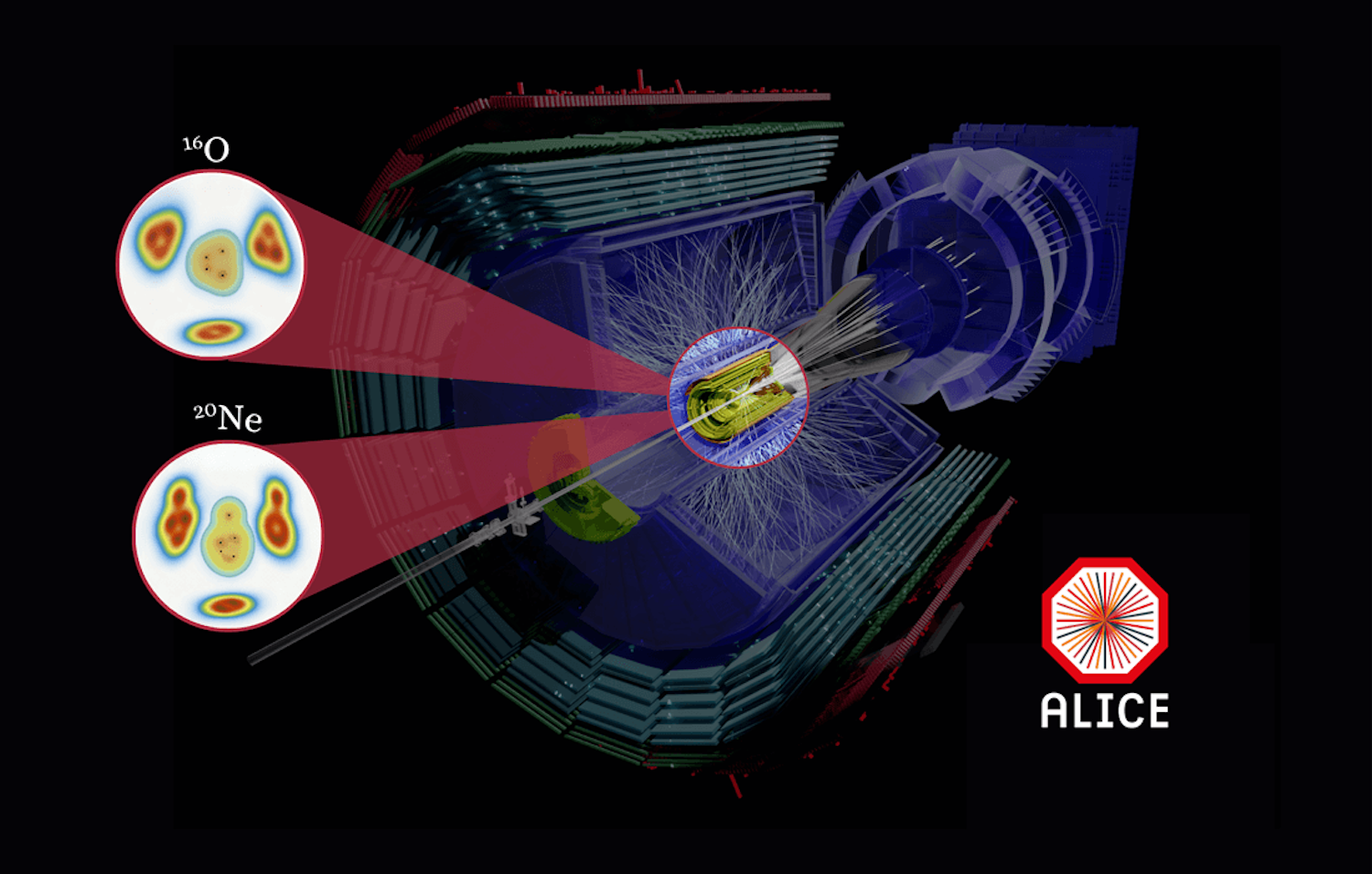
In this case, Zou and colleagues examined the aftermath generated by firing the smaller nuclei oxygen-16 and neon-20 at each other. While the team can’t observe the collision itself because the interaction happens so incomprehensibly fast, they can study the particles and the shape they form not long afterwards. Study co-author and Neils Bohr Institute physicist Emil Gorm Dahlbæk Nielsen likens the situation to the properties—and absence—of light.
“It is a bit like shining light on an object and seeing its shadow. You cannot see the object directly, but its shadow reveals its shape,” he said. “In the same way, the movement of the particles reveals the geometric shape of the atomic nuclei that was present at the beginning of the collision.”
Physicists now know that a collision between two oxygen nuclei generates a more rounded particle pattern, while crashing neon nuclei together creates a pattern more reminiscent of a bowling pin. But while these smashed atomic components reveal that it actually is possible to create quark-gluon plasma using lighter elements, it doesn’t mean oxygen or neon nuclei were present so soon after the big bang. That said, we are still one step closer to discovering the actual culprits. The next phase will yet again involve smashing atomic nuclei—this time using even lighter candidates like helium-4.
For Zhou, it’s i compelling that a single experiment can help physicists learn about atomic nuclei structures while simultaneously recreating some of the universe’s earliest moments.
“These two things turn out to be much more closely connected than one might initially think,” he said.
The post Scientists smash atoms together to create ‘little’ big bangs appeared first on Popular Science.
from Popular Science https://ift.tt/WtPbHRs





0 Comments