
It’s understandable if you’ve never heard of the coastal marten. These secretive—but adorable—woodland carnivores nearly went extinct. Fortunately, these ferret-sized mammals are making a slow recovery in the forests of the Pacific Northwest.
Coastal martens (Martes caurina humboldtensis or the Humboldt marten) are related to weasels, otters, mink, wolverines, and fetters. These rare mammals are smaller than the average house cat with adult males averaging about 20 to 24 inches long and weighing about 1.5 to three pounds. Martens are carnivores known to eat birds and their eggs, small mammals like chipmunks, berries, and nuts.
They once ranged all over parts of northern California, southern Oregon, and Washington State, but their population and range shrunk during the 20th century. The animals were valued for their fur and often trapped and skinned, while logging destroyed much of their habitat. They were almost considered extinct until a United States Forest Service biologist discovered a small population in the coastal woods of northern California in 1996. They are currently listed as threatened under the Endangered Species Act and the small populations of martens that remain are at risk due to habitat loss, rodenticides, vehicles, and disease.
Scientists from Oregon State University (OSU) recently spent three months documenting the marten population in northern California. To get a sense of the population there, they used non-invasive survey tools, including remote cameras and hair snares. These snares use tape and wire to safely sample hair from animals to collect DNA and other data. The team gathered their marten data via 285 hair snares (made from PVC pipe) and 135 cameras.
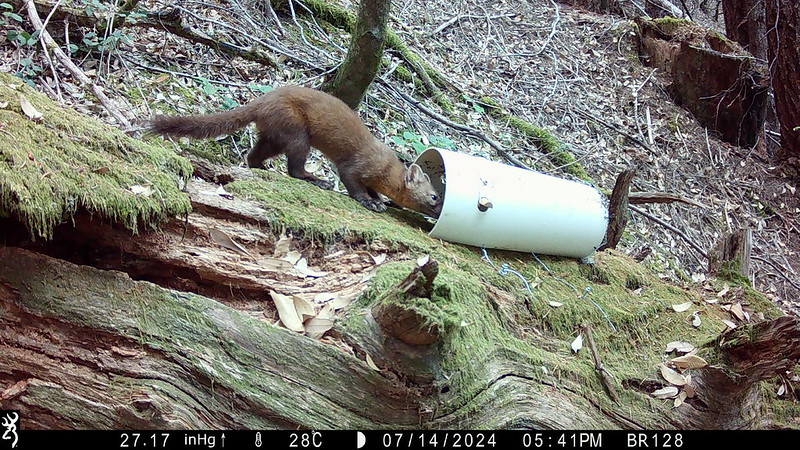
The genetic analysis of the hair identified 46 different martens (18 females and 28 males) living in Klamath, California. At higher elevations, the biggest groups of martens were observed along forested ridgetops with consistent snowpack in the winter. At lower elevations, they were spotted in ravines and wetlands in coastal forests.
The team’s findings are detailed in a study recently published in the journal Global Ecology and Conservation. Understanding where these carnivores are living is crucial for informing conservation and land management decisions.
“Martens tend to select forest stands with greater than 50% canopy cover and lots of large-diameter trees, snags and hollow logs,” Erika Anderson, the study’s lead author and OSU faculty research assistant, said in a statement. “Structural complexity with coarse woody debris helps them hunt and also provides cover from predators and competitors. But despite continued conservation concern over the last 30 years, we have a lot to learn about marten distribution and demography and how forest conditions influence their distribution and density.”
The study included organizations from Oregon, California, and Wisconsin and took place on ancestral lands of the Yurok and Karuk Tribes. One-third of the study area is owned by the Yurok Tribe, and that land was previously owned and managed for commercial logging. The Yurok Tribe now manages the land for some timber harvesting, plant and wildlife habitat restoration, and cultural resource conservation.
“Coastal martens like forests with old-growth characteristics and those types of forests are being threatened by the effects of climate change, including more frequent and severe wildfire, and certain forest management practices,” added study co-author and OSU wildlife ecologist Sean Matthews. “Beyond that, there’s a lot we don’t know about this species, including information as basic as what forests do coastal martens still occupy, how many martens are there, and are these populations increasing.”
Matthews also describes coastal martens as “among the most adorable animals that call our Pacific Northwest forests home.”
The post Adorable ferret-sized martens are rebounding in California appeared first on Popular Science.
from Popular Science https://ift.tt/cqkdDLT




0 Comments