
New research gathered with the help of a free-to-play video game indicates most people are happy to help their fellow neighbors, even if it costs them a bit of cash. According to the designers of Race Against Rot, their social experiment suggests that some new strategies to address longstanding issues facing both small-scale farmers and their nearby communities could be beneficial.
Environmentalists and sustainable food system advocates alike have long stressed the importance of supporting small farms, but it’s easier said than done. Despite the clear health and environmental sustainability benefits, shopping local generally means spending much more money—often at seasonal markets. Overall, this makes it especially difficult for low-income families and those living in food deserts to access quality ingredients.
The cost problem isn’t from price-gouging farmers, but the state of the overall industry. The vast majority of farms in the United States are struggling. The U.S. Department of Agriculture (USDA) estimates around 88 percent of the industry falls under the “small operation” designation, meaning they earn less than $350,000 annually in gross sales. Factor in costs, and less than half of U.S. small farms actually generate any profit at all.
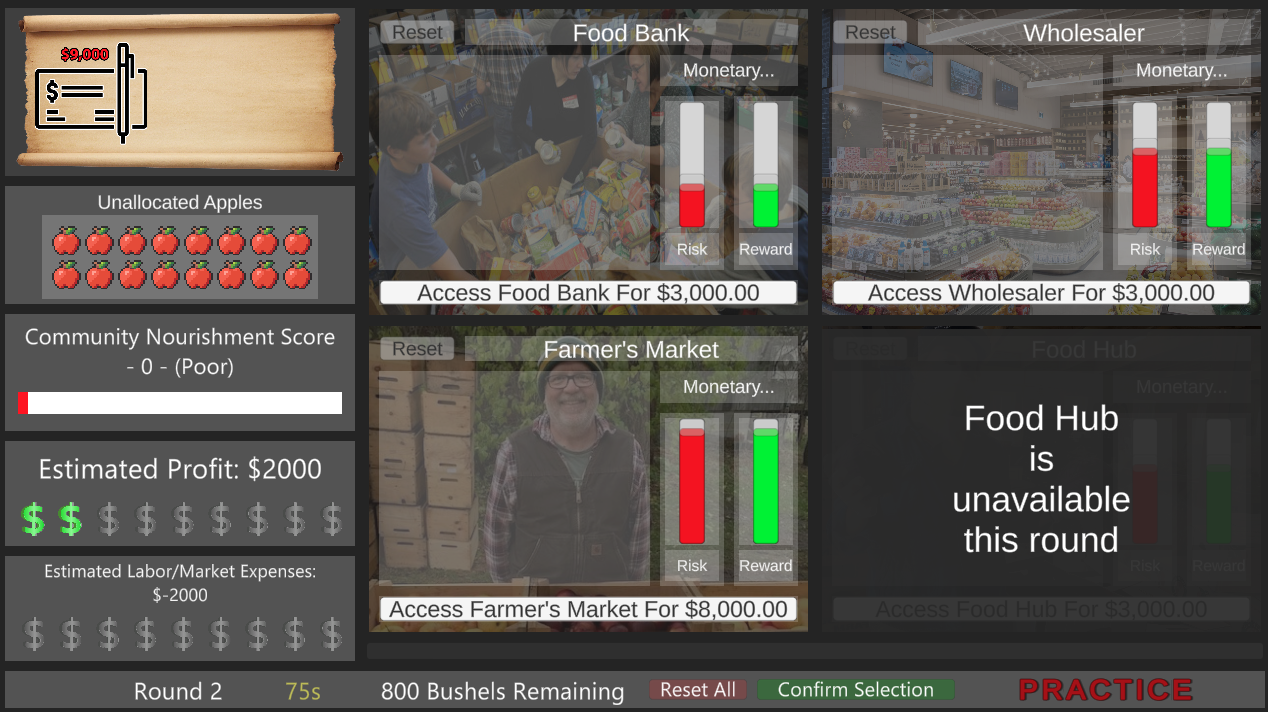
In 2023, researchers at the University of Vermont built a simulation game called Race Against Rot to illustrate the uphill battles facing farmers. In the game, players took on the role of a small apple orchard operation and worked to maintain profitability through multiple policy scenarios. These included opting for farmers market or wholesale distribution options, paying a universal basic income to their workers, and supporting localized food hubs.
To incentivize the over 1,000 people who participated in the game, players could earn actual cash payouts of $1 per every $40,000 of orchard profits. But instead of walking away with the most pocket change possible, most Race Against Rot players opted to make less money in order to help supply their neighbors with healthy fruit. They called this concept of fostering local wellbeing “community nourishment.”
“We found that there was a very, very strong commitment to a value structure around community nourishment,” principal project investigator Amy Trubek explained in a recent university profile.
Food systems researcher Carolyn Hricko, co-author of a recent policy report based on the team’s findings, said it was “very heartening” to see random players adopt altruistic practices even during a simulated experience.
“When they walked in the shoes of a farmer, [they] came out the other side saying they’re willing to support community nourishment alongside their ability to stay in business, theoretically,” she said.
Trubek and Hricko know that reality is far more complicated than a video game simulation. People often behave more selfishly when consequential amounts of money—not to mention livelihoods—are on the line, and the global agricultural industry can’t be distilled down to a hypothetical apple orchard. At the same, most of today’s food distribution systems aren’t designed with this concept of community nourishment in mind. By beginning to consider the social implications of a game like Race Against Rot, policy makers could discover new and effective ways.
“Equitable food systems solutions can only emerge from questions posed and data gathered that honestly reflect the structure and function of both our current food system and any vision for a better one,” the policy report authors wrote.
Thanksfully, that vision of a better system is something most people want to see realized.
“The public really cares about community well-being and the success and livelihoods of farmers. That’s great news,” added Hricko.
The post Test your apple farming skills with this free video game appeared first on Popular Science.
from Popular Science https://ift.tt/h8QzWnF




0 Comments