
A field in northern Serbia harbors a horrific secret dating back at least 2,800 years. At the Gomolava archaeological site roughly 35 miles west of Belgrade, researchers uncovered one of the largest known group burials of its kind. The mass grave contains the remains of over 77 murdered individuals, mostly women and children. Despite the macabre scene, the excavation also features unexpected details that suggest a complicated moment in Early Iron Age Europe. The discoveries are detailed in a study recently published in the journal Nature Human Behaviour.
Mass graves are unfortunately common across ancient locations around the world, with many prehistoric examples dotting present-day Europe. While these burial sites frequently include the remains of closely related victims, Gomolava houses a notably different situation.
“When we encounter mass graves from prehistory with this kind of demographic, we might expect they were families from a village that was attacked,” study co-author and University College Dublin archaeologist Barry Molloy explained in a statement. “Gomolava genuinely took us by surprise when our genetic analysis showed the majority of people studied were not only unrelated, not even their great–great-grandparents were.”
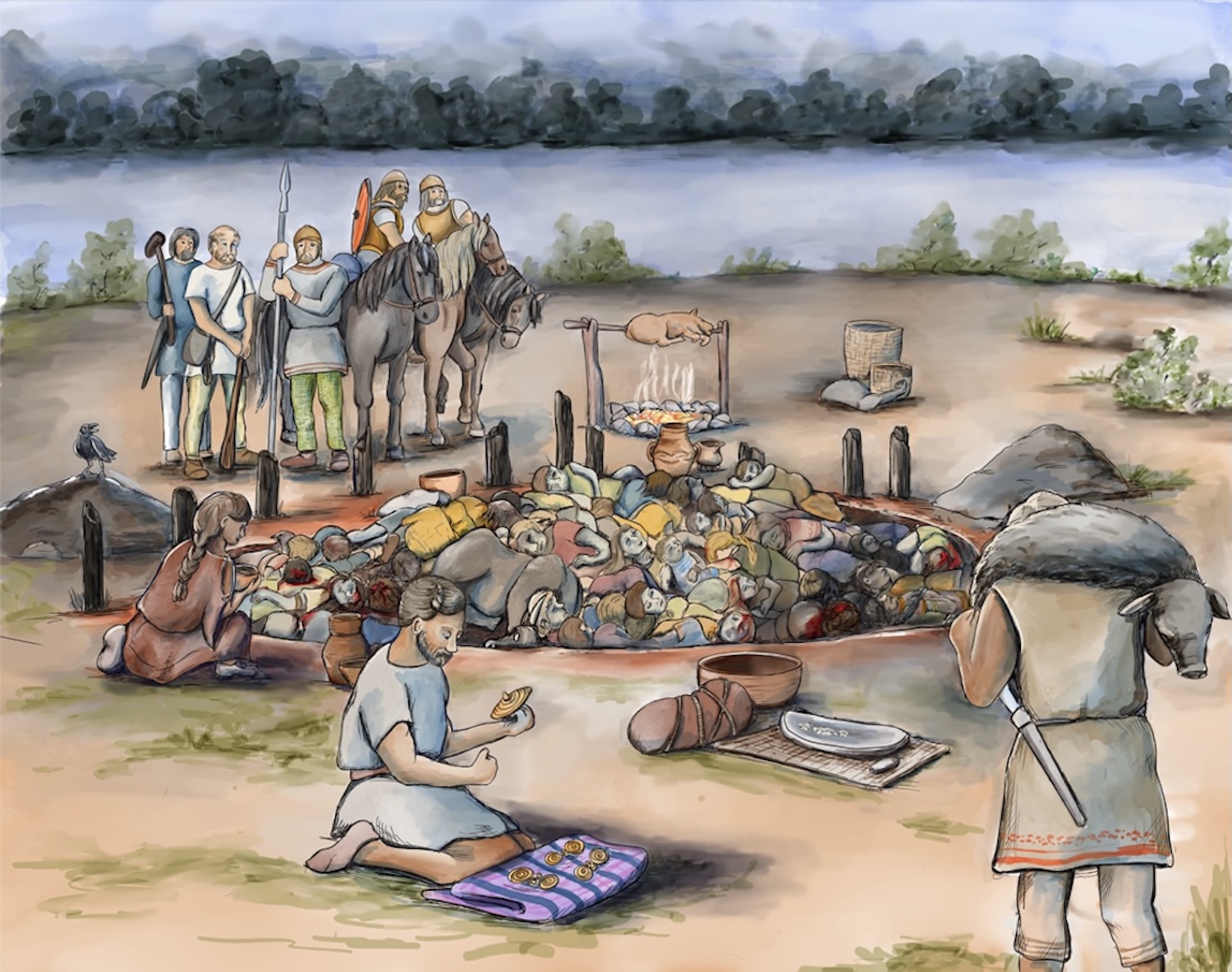
Closer examinations of the remains indicate the genetic strangers weren’t captured warriors, either. About 87 percent of the deceased were female, while 40 were children between one and 12 years old. Another 11 were adolescents and 24 were adults. Researchers only identified a single infant—a male.
Most displayed signs of bludgeoning and stabbing, but their interment was far from haphazard or careless. If anything, the perpetrators took great care in preparing the burial site.
“It is typical in prehistoric mass graves for victims to be hastily buried together in a pit, maybe by survivors or even their killers,” said Molloy.
But while Gomolava’s deceased were quickly buried in an abandoned semi-subterranean house, they weren’t buried by themselves.
“Uniquely, not only had the bodies not been looted of their valuables, offerings were made in what must have been a respectful ritual,” he added.
Uncovered artifacts included bronze jewelry, ceramic drinking vessels, and even the remains of a butchered calf. The amount of effort and time required to complete the task implies the mass murder was part of a larger, symbolic ceremony.
“The brutal killings and subsequent commemoration of the event can both be read as a powerful bid to balance power relations and assert dominance over land and resources,” suggested University of Edinburgh archaeologist and study co-author Linda Fibiger.
Given the genetic diversity and the choice of victims, the team believes these deaths weren’t necessarily a byproduct of warfare. Instead, they were a warning to neighboring communities.
“What we found at Gomolava tells us that as things recovered in this area moving into the Iron Age, reasserting control over landscapes could include widespread and extremely violent episodes between competing groups,” Malloy said.
According to study co-author and University of Copenhagen archaeologist Hannes Schroeder, the violence may also have explicitly targeted women in children as a way to sever family lineages and weaken rival communities.
“Beyond documenting a single tragedy, our findings speak to human behavior in times of upheaval,” said Schroeder.
The post One of Europe’s largest Iron Age mass graves contains mostly women and children appeared first on Popular Science.
from Popular Science https://ift.tt/N3EjxmS


0 Comments