
In February 2025, I went to Creswell, Ore., to see whether cult putter manufacturer L.A.B. Golf’s zero-torque premise could do something no golf instruction or my own overactive brain ever could: remove a variable without removing me from the process. In March 2026, I went back on the heels of something heel-shafted—L.A.B. Golf’s unusually country-club-coded LINK.2 blade putters, a more familiar silhouette from a company better known for shapes that look like dares. This was the growing company’s clearest attempt yet to package its zero-torque worldview in a shape traditionalists might actually recognize (and embrace). An older golfer at the Springfield, Va., country club where I first tested a stock LINK.2.1 looked it over lustily and declared it the “Patek Philippe of putters.”
My takeaway from that first visit wasn’t that L.A.B. had invented a magic wand. It was that Lie Angle Balance—the company’s namesake way of building putters so they resist twisting and stay more stable through the stroke—could strip out one of putting’s smallest, most persistent frictions. You still have to read greens. You still have to manage pace. You still have to live with your mishits … your many, many mishits. But the right club will stop asking for so many mid-stroke negotiations.
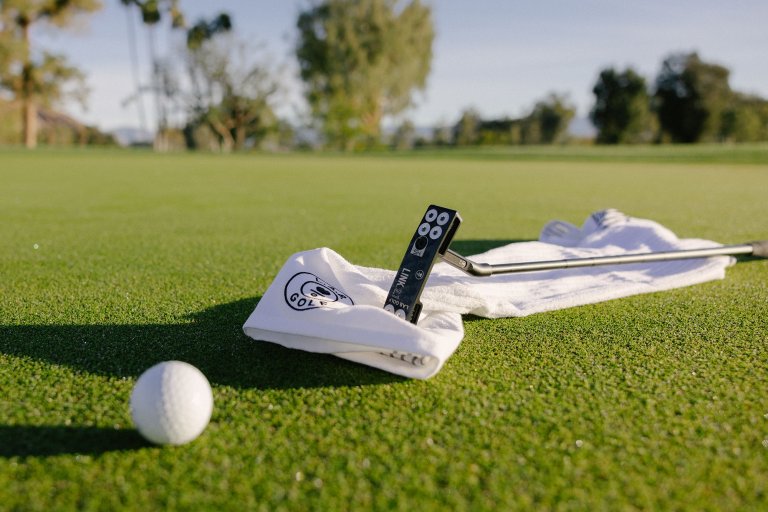
L.A.B. Co-founder Sam Hahn, also the company “Sultan,” according to the placard outside his office, has long argued that “zero torque” is really a simplification. What L.A.B. is building is really a kind of corrective torque, not the absence of force so much as technology to deliberately manage those forces so the golfer has to do less of it by hand. That sounds like the kind of distinction only a putting obsessive could love, but it gets at something central to how the company sees itself now: not just as the loudest name in a buzzy category, but as a steward of defining it more objectively.
A year later, L.A.B. Golf is in the same location at the edge of the Emerald Valley Golf & Resort, but in a very different place in the industry. It is no longer simply an oddball putter company in its Pacific Northwest bubble, making heads that once inspired equal parts inquisition and zealotry. It is now a company navigating two kinds of validation at once: financial and golfing.
__________
The first came in the form of acquisition by private-equity firm L Catterton, a drawn-out process Hahn described as “excruciating” because it came at a time the company was already growing at “an absolutely absurd, pretty unprecedented rate.” The second came in June 2025 when J. J. Spaun sank the winning 64-foot putt at the 125th U.S. Open with a custom L.A.B. DF3 putter [shown in the air below right], a moment Hahn called “the perfect closure to chapter one,” and one that left the company, “in a small little way,” “officially etched into golf history.”

L.A.B. has been slowly carving out its presence since 2018, but looking around Hahn’s office, you’d be led to believe L.A.B. had been part of golf history for the better part of a century. There’s a picture of Arnold Palmer circa 1953 with his L.A.B. putter. And there’s Richard Nixon with one. And there’s Ty Webb with his. Sure, they’re all photoshopped printouts, but after the last year, it wouldn’t be that hard to replace them all with actual photos from the Tour. You never know what can happen at Augusta National.
Walking through the building, it felt more like a company that could keep up with the $200 million-plus endeavor it had become. The deal didn’t so much change L.A.B.’s identity as remove bottlenecks from a company that was already outgrowing its old shape. Luckily, it’s a company that has no issue with new or odd shapes.
Last year, I saw a place straining at the seams. This year, I saw the same weirdness, but with more room to breathe. More space for conceptualizing and prototyping, a Ted Lasso-style “BELIEVE” sign sitting on the shelf above a workbench. More space for a six-axis precision measuring arm. More dedicated CNC machines for production. More repeatability. More order. Literally fewer walls to make the equipment and 250-plus employees all fit. Same dedication to hand-balancing and verifying every single one of the 1,500-plus clubs that leave the facility daily.


Lead times that once stretched to 14 weeks are now down closer to two on some builds, the result of what Director of Manufacturing Engineering Kevin Martin described as an effort “to level up everywhere in the company, from here to production, from equipment to processes across the board.”
Part of that leveling up involved the LINK.2 challenge to determine head material and shape, entry point of the shaft, hosel design, and weighting to deliver L.A.B.’s forgiveness with limited perimeter to manipulate. Martin also addressed the obvious anxiety that comes with private equity in any enthusiast niche: “The biggest fear … was that our stuff is going to slip once we get bought by PE, but we haven’t seen that at all. We’ve actually been requested to do everything with a higher standard than we had before.”
Identifying and addressing pain points matters because L.A.B. still does not really make a mass product, even as it has achieved a critical mass of product. Putters still cost $499 stock up to $1,299 custom, offering an increasing number of shapes and components. Of course, L.A.B. is hardly alone in treating putters as an active design frontier. Across golf, manufacturers have been experimenting with new processes, new geometries, and new materials—from multi-material constructions to 3D-printed heads—in an effort to chase stability, consistency, and feel. L.A.B.’s distinction is that all of its experimentation keeps circling back to the same central thesis: remove torque, then fit the rest around the golfer.
Hahn told me the modern golf consumer is “less susceptible to BS marketing than they’ve ever been,” more informed and more interested in “scientific reality.” That has suited L.A.B., who continue to work on ways to quantify zero-torque’s legitimacy. But it has also forced the company to learn a broader audience in real time. There will always be hardcore mallet guys, real L.A.B. rats, but the LINK.2 invites a new Newport crowd to go from intrigued to convinced. That same maturation shows up in fitting.
__________
Last time, the fitting, which was done adjacent to HQ on the club’s putting green with a couple of golf bags of samples, felt like an outdoor mood board with physics. This time, it happens inside a dedicated studio, on a course-like artificial green lined with roughly 250 L.A.B. configurations. That’s not all the millions of potential builds, once you factor in every variation of alignment marks and other aesthetic customizations, but it’s enough to make the point and properly inform the customer perspective.
Senior Fitting Specialist Tyler Falk, who fit me [several paragraphs below, in orange], says we’re only working with the “24 pack of crayons versus the 96 pack,” because we’re starting with just the recently released LINK.2.1, LINK.2.2, and DF3i models, not every conceivable version. However, we have more than enough to stop pretending this is just a vibe check. And there are those who come in excited to try anything and everything. Different strokes for different folks, as they say.


This room is the clearest symbol of where L.A.B. is now. The first time I stood here, it was an unfinished mound. Now it’s an inviting in-person pilgrimage. The company still sells a philosophy, but it has become much better at measuring how that philosophy meets an individual golfer. My first fitting was a conversation about shape, alignment, shaft feel, and preference. This one is also a conversation about data.
After some initial putter introductions and subjective impressions, Falk walks me through Quintic ball-roll readings and the kind of launch-monitor scrutiny that doesn’t care what I think I want. I hit a series of balls, high-speed cameras measure what happens at impact and during the first second(s) of roll, then we turn to a large screen dotted with reds and greens. The goal, he explained, is forward rotation and getting away from putts that skid or backspin and force you into inconsistent pace corrections. That was inconvenient news for my ego.
I came in thinking I would probably leave with some custom version of the LINK.2, probably with the fanciest TPT carbon fiber shaft because more expensive = better, right? That would best flatter the fantasy I have of the golfer I could become, striding up unassumingly, nonchalantly, and finding the bottom of the cup repeatedly from 20, 30, let’s just say 60 feet. But as the session unfolded, the evidence kept nudging me elsewhere.
___________
What we found after an hour was that the DF3i with a GEARS shaft addressed, more than anything, my need for steadier distance control and a build that would hold up better when my stroke was less than perfect.
The LINK.2.1 and LINK2.2 were not rejected. They were simply not the answer to the question my stroke was asking. Falk’s language around it was refreshingly unsentimental. With the LINK2.2 and an ACCRA shaft, the numbers were good. With the DF3i and GEARS, they were more resilient. He told me there is “no single shaft” that automatically performs better because of price or prestige; the point is matching profile to player.


In my case, he says, the steel shaft “entered” my transition a little too much, the $250 Diamana carbon fiber upgrade was still a bit too stiff, and softening that profile “just a little bit” with GEARS graphite [available for “only” $175 more but clearly not a tier below] was where he “started to see your distance control really improve.” He liked the DF3i because my mishits produced better launch-and-roll numbers and because the head’s forgiveness made it the build that would “cooperate day in and day out the most consistently.” Different strokes for different folks, as they say.
That result made more sense once I understood how much L.A.B. now thinks about synergizing head materials and shaft materials in the same mechanical conversation. Vice President of Engineering Brian Parks explained that in a multi-material head—for instance, my DF3i’s aluminum body with a stainless-steel face insert—different materials create different sounds and sensations at impact.
Scientifically, they model those frequencies and try to tune out the kinds of pitches that feel obtrusive. Subjectively, though, there is no universal answer: some players want a click, some want something duller and more muted, some want a more metallic note. The engineering can narrow the field, but preference still finishes the job.


The shaft side is no less nerdy, or no less personal. Parks says the whole point of working with manufacturers on a growing shaft menu is “sound and feel,” with differences in composite density and stiffness changing how impact is transmitted. L.A.B. measures both frequency and deflection on 37” shafts: TPT sits at the stout, instant-feedback end of the spectrum, while ACCRA gives more visible deflection and a lower, softer sensation.
GEARS lives in a particularly interesting middle ground. Its filament-wound construction was described to me during the fitting as the graphite shaft that most closely mimics steel, but Parks explained that its structure is more nuanced than that. It has a stiffer section up in the butt, then softens lower down, which gives it a feeling of stability while still letting the player sense the head and hear a more muted sound. In my case, 268 Hertz so good. Come on, baby …
That was useful context, because it meant the DF3i choice was not just about head shape. It was also about how that head’s insert and that shaft’s profile worked together for me. The insert version gave me a firmer, more energetic response than the softer all-aluminum on-rails DF 2.1 that spoke to me on my original visit but had recently felt too mushy, hence my ill-founded belief I was entering my competitive era. And the GEARS shaft kept that response from becoming overly sharp or overly demanding, which was the primary thing holding me back from the heavier, all-steel LINK.2. In terms even I could understand: enough pop, enough stability, not too much drama, which turns out to be the company’s story, too.
__________
What seems clearer a year later is that L.A.B. has not grown by hardening into dogma. It grows by staying flexible inside a rigid premise. Lie Angle Balance, eliminating torque to reduce the need for constant face management, remains the same. But the company keeps finding new ways to meet golfers where they actually are, not where tradition says they should be. Director of Player Development Liam Bedford tells me a story over dinner that perfectly illustrates this.
Pro Camilo Villegas wanted a setup L.A.B. did not really have at the time: a split-grip, counterbalanced-style build that would let him quiet his hands and keep the putter moving more like a single unit. So the company worked up a custom build: a MEZZ.1 Max with about one degree of shaft lean, a 74-degree lie, and a 17-inch grip. Bedford says it became “the first-ever counterbalance putter we built.”
More importantly, when Villegas needed a backup, Bedford says it was “the first time in [our] history that we got feedback that we were able to replicate a build” so precisely that the player “couldn’t tell the difference between the two of them.” This burgeoning confidence and machining prowess meant that what started as a specific tour-player solution could become a direct retail category you’ll find on the L.A.B. site today.
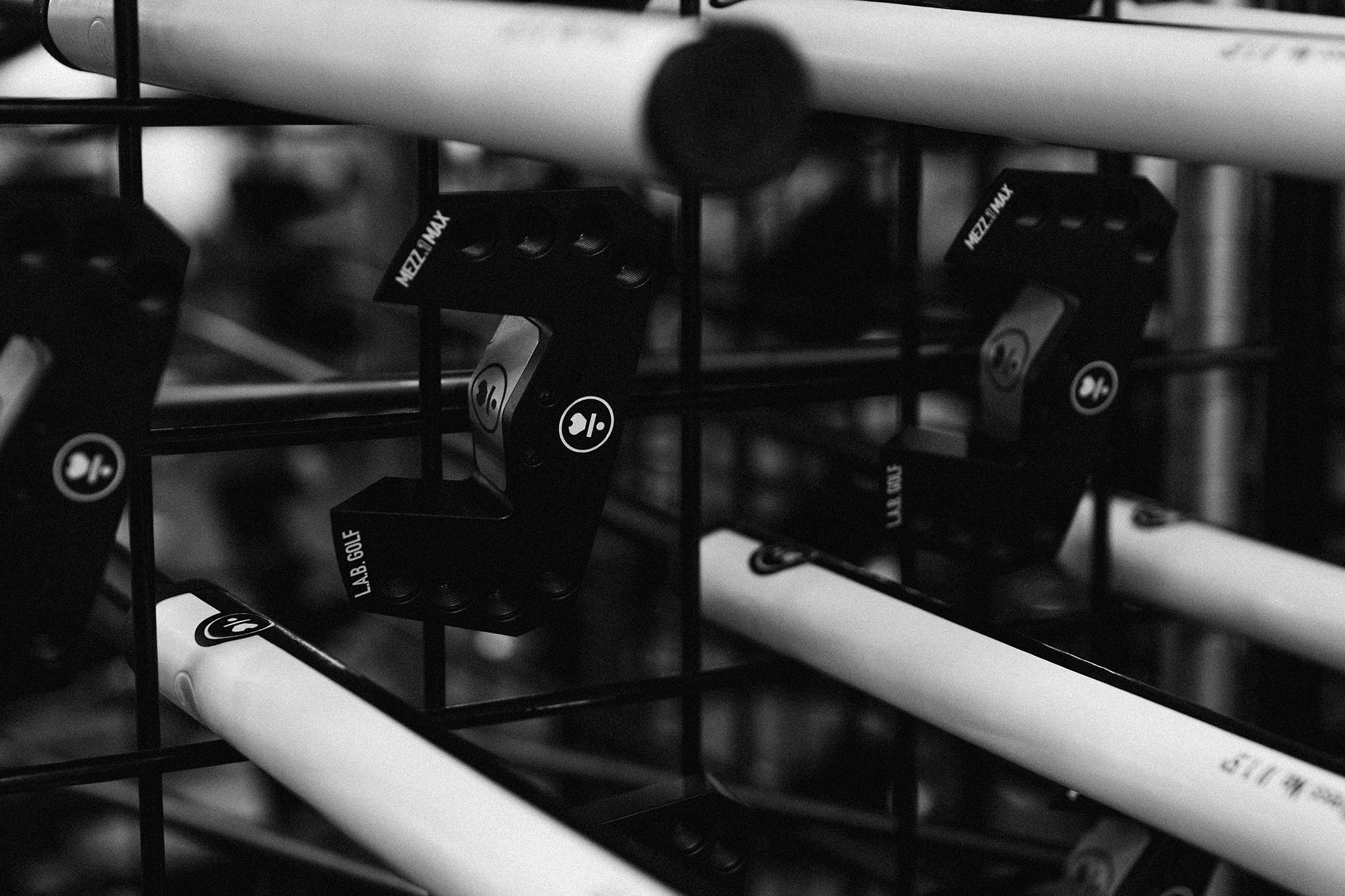
That says something larger than one tour anecdote. L.A.B.’s evolution has involved learning how to turn one-off experimentation into repeatable customization, how to translate an individual golfer’s odd-seeming needs into something real, manufacturable, and eventually scalable. Even palatable, as the increasing acceptance of the original Direct Force putter and its offshoots has shown.
Another professional’s name fits here, too. Adam Scott. Bedford described the development of what became the MEZZ.1 Max began after Scott wanted L.A.B. to explore a larger concept. Bedford and the team tinkered late into the evening, rebalanced the perimeter, and realized, in Bedford’s phrasing, “oh shit, this is good. This is better.” What stands out is how organic the process sounded: not a top-down product brief, but a player’s need becoming a real product because the right people were curious enough to follow it. As Martin puts it, that is simply “how we operate.” Somebody says something, it sparks an idea, and eventually that idea becomes something you can buy. [And, yes, it was reportedly Scott who introduced Villegas to the putter.]
This makes my own fitting feel less like a separate consumer experience than part of the same company logic. Tour players helped push L.A.B. into new categories. Admittedly, I’m not doing anything so consequential, but I went through a similar basic process: arriving with a set of assumptions, preferences, and self-descriptions, then watching the evidence quietly reassemble them into a custom product.
__________
A year ago, I was fascinated by how L.A.B. putters seemed to reduce micro-adjustments. This time, what struck me was how the company’s expanded fitting process reduced self-mythology. Before, I knew nothing. This time, I thought I knew something. Both times, I learned there was more to know. Fitting politely told me something I sensed deep down: my taste-led instincts could actually benefit from some real problem-solving. At the end of the day, every L.A.B. putter stays square, but with a little effort, you can find the one that squares with playing style and personal style.
That lesson lines up neatly with how Hahn described L.A.B. itself at this moment. Speaking about his own swing changes and the company’s evolution, he says you eventually end up with an identity that reflects accumulated choices, habits, and limitations until those no longer fit the present version of you. Then the challenge is whether to become “a frustrated, middle-aged guy who talks about how good he used to be” or to “accommodate my new self.”
L.A.B., Hahn says, is facing the same thing: “Chapter two has to look different. Our body’s changing. The goals are changing, the processes are changing. The audience is changing, and we need to change with that.”
A year ago, my trip to L.A.B. taught me that odd-looking equipment can become intuitive once you stop fighting it. This year, it taught me something slightly more annoying and therefore probably more valuable about how I should stop fighting myself. Improvement is not always about becoming more like the golfer you imagine yourself to be. Sometimes it is about accepting the golfer the numbers have already identified.
I went in expecting to choose on taste and leave with something sleek, blade-adjacent, and flattering to an aspiring flagstick artist’s sensibilities. Instead, an indoor green, walls of options, and a lot of patient evidence pushed me less fantasy, more fit. Less Patek Philippe, more Gimmie Getter. Less projection, more cooperation. Less me as I’d like to be seen, more me as I’d like to actually putt. Eventually becoming the me that drained it rather than duffed it.
Which, if I’m being honest, is the most L.A.B. Golf lesson imaginable …
… but don’t worry: numbers may have chosen the DF3i, but I chose it in purple, with skulls etched on the sole, a memento mori reminding me to embrace a little weirdness every day.


The post A year later, L.A.B. Golf’s weird science got bigger … and more personal appeared first on Popular Science.
from Popular Science https://ift.tt/qzj463o


0 Comments