
When was the last time you recalled a looming dentist appointment off the top of your head? Or memorized a phone number that wasn’t also the lyrics to an interminable commercial jingle? If the answer escapes you, it’s likely that you use notes apps, phone cameras, voice memos, and schedulers to outsource the documentation of your memories and commitments.
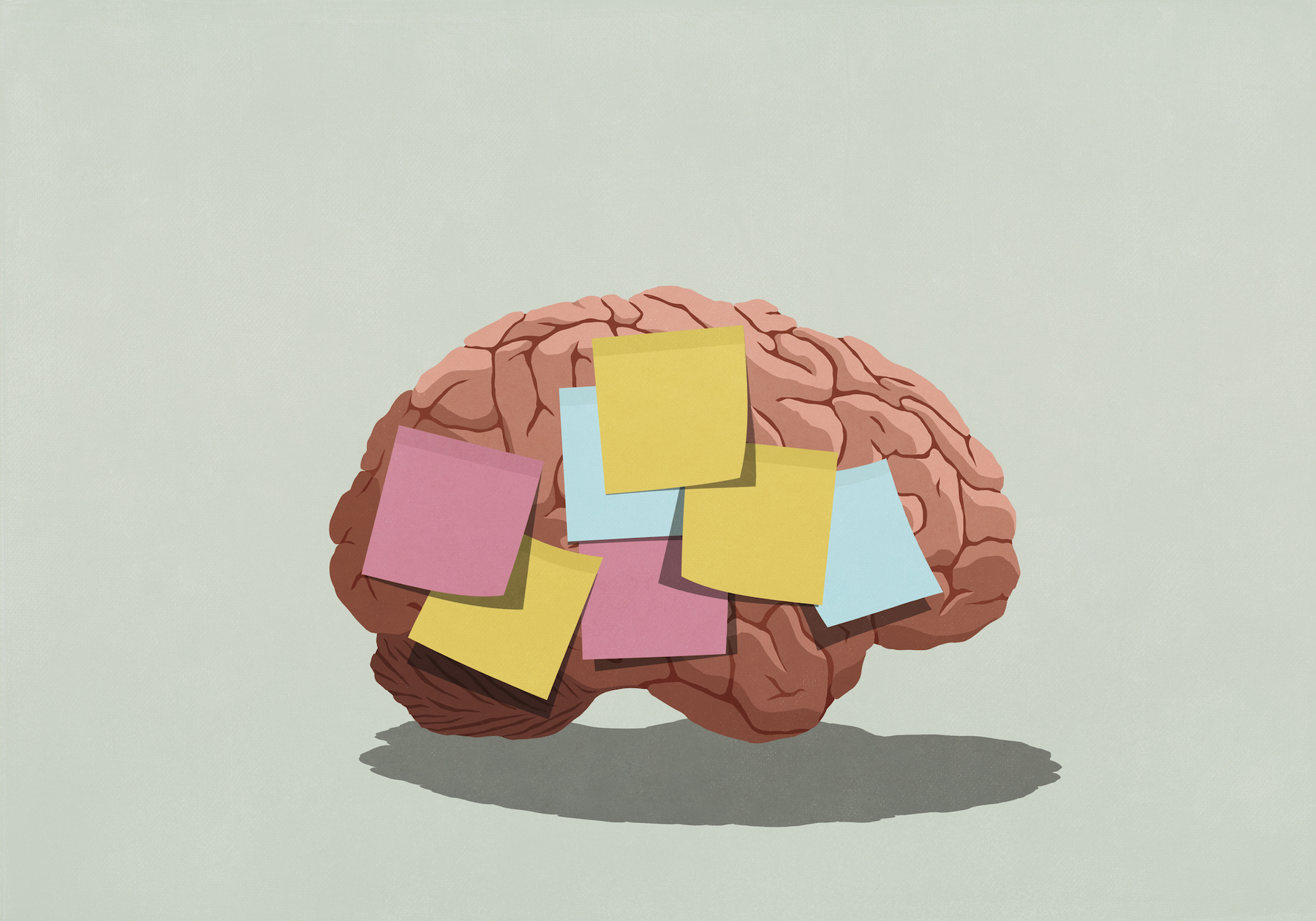
Psychologists call it cognitive offloading, and it’s been a real boon to the convenient, efficient, and effective cataloging of the ever-swelling amount of information we consume daily.
“Generally, this type of offloading does enhance our performance,” says Julia Soares, Ph.D, assistant professor of psychology at New Mexico State University.
But not without taking a cut. Recent research is providing greater insights into the effects of transferring cognitive function to external media, and there’s evidence they’re not all beneficial.
Is all of this snapping, recording, logging, and storing a net gain for us mentally, or are we handing over too much brainpower to the machines? Well, after recording expert interviews via Zoom, transcribing them with AI, and substantiating it all online, we have answers!
What Is cognitive offloading?
“Cognitive offloading is when we use external devices—sources other than our brain, really—to complete a cognitive task,” Soares says. She notes this can include something as mundane as counting on your fingers, but when we document information, “we’re relying on the prosthetic memory or source available to take some of the responsibility of remembering on our behalf.”
To some extent, this phenomenon has existed as long as cave drawings. But technology is rapidly replacing a lot of the thinking we’ve done since human inception, with different devices and programs shouldering (braining?) different shares of the load.
Of particular focus for researchers studying the effects of digital documentation are the areas of prospective memory, working memory, and factual recall. It may be helpful to think of them as the ghosts of cognition’s past, present, and future. (Unless you’re just going to copy and paste this information somewhere, in which case don’t worry about thinking of them at all.)
- Prospective memory regards information about a future point in time. For instance, remembering an upcoming concert or scheduled business meeting.
- Working memory functions like computer RAM, temporarily holding new and existing information for present use, as with taking notes or following directions.
- Factual recall concerns information you already know and must retrieve, as if from a human hard drive. You use this when playing trivia or remembering where to turn next while driving.
Cognitive offloading subcontracts much of these functions to technology, pinging us with reminders, converting spoken instructions to text, and storing huge, searchable volumes of data.
| Technology | Examples | Cognitive Function |
| Scheduler | Google/Apple Calendar | Prospective memory |
| Note taker | Voice Memo, Otter.ai | Working memory |
| Search engines/chat bots | Google, ChatGPT | Factual recall |
How does cognitive offloading affect your brain?
When you document, or offload, important information (like photographing where you parked, or adding a number to your phone), your brain’s traffic controller reroutes processing in two ways:
Flush the data. This part of the process signals your brain to jettison the offloaded information from short-term storage, recognizing that a duplicate copy safely exists elsewhere.
Reassign bandwidth. With the high-value information safely offloaded, your brain reallocates the newly freed-up cognitive capacity for additional data and/or functions.
At its best, cognitive offloading helps lighten your mental workload. By farming out data storage to technology, you alter brain function from resource-intensive information maintenance to an open, more flexible state, freeing up limited working memory for other business.

Benefits of cognitive offloading
The benefits of cognitive offloading are as vast and varied as they are obvious.
1. Conserves cognitive effort
The brain burns about as many calories as any single organ in the body, so its use comes at a premium. “We’re pretty miserly when it comes to our limited cognitive resources,” says Dr. Evan Risko, Ph.D, professor and chair of psychology at the University of Waterloo.
So, sloughing off tasks like attention and memorization to computing can free us from the interference of nonessential information. Just a few years ago, you may have memorized dozens of numbers that a smartphone’s address book now does the work of remembering.
“Maybe we know a handful of phone numbers, but now when I try to think of my emergency contact number, there isn’t as much interference,” Soares says. “I don’t have as many numbers coming to mind as if I had memorized 50 phone numbers the way I might have before.”
2. Ensures greater accuracy
The human brain is still the most powerful computer on Earth, but it’s as prone to hallucinations—known in human intelligence as confabulations—as any bot. The ones and zeroes of digital information processing and storage make offloaded information more reliable.
“If I can look up information online, so long as it’s accurate I’m going to be less error prone than if I’m relying on memory, which we know can become flawed, which can degrade with time, with interference, with other relevant information coming to mind,” Soares says.
3. Promotes higher-level understanding
If you’re not expending precious brain wattage on recording information, you should, in principle, be able to focus more on the information itself, cultivating a greater mastery of the subject matter. Risko uses the recording of our interview with him as a case in point.
“By offloading this to technology, you’ve saved those resources that you would have invested in parallel note taking, which should benefit your ability to understand what I’m saying and think about it intelligently and respond with follow-up questions,” he says.
Costs of cognitive offloading
Wherein we ruin your plans to meld with the Matrix.
1. Diminished working memory and recall
By documenting moments and facts with digital ease, your brain’s ability to encode and retain that information in long-term memory can become impaired over time. The phenomenon is referred to by cognitive psychologists as digital amnesia or the “Google effect.”
Researchers conducted a test of recall by tasking several groups of participants with reproducing a sequence of colored squares from memory. Those who offloaded more information—measured by the frequency with which they referred to the source sequence—performed better at the immediate task, but retained less information long term.
“The main theory we’re working on with how cognitive offloading impairs memory is called the study-effort hypothesis,” Soares says. “And the idea is that we don’t put as much effort towards studying information that we know is going to be externally available.”
She adds, “When you save little bits of information, like trivia facts on a computer, you’re less likely to remember it when you’re told it’s saved than when you’re told that it’s deleted.”
2. Impaired decision-making
Retrieving information from your brain strengthens memory pathways. When you devolve that recall to external devices, the brain can become conditioned to lean on these tools as an extension of itself.
On a long enough timeline, this dependence on computer-generated responses can inhibit your own judgment, making it harder to improvise when technology invariably fails.
The accuracy threshold for determining whether thought automation is a net benefit or a liability is around 70 percent. That means a computer can misinterpret three out of every 10 things you offload onto it and still be considered worthwhile. That’s good for a C-minus in elementary school.
3. Misprioritization of information
With the ability to more readily chronicle everything we do and see, the threshold for what constitutes a memory worth documenting drops considerably. This is why—or, maybe, because—people who offload important information suddenly show a massive improvement in remembering the minor, low-value details they didn’t store.
A surprise memory test of research participants revealed that, when high-value information was documented externally, the ability to recall it via the brain was reduced. Ironically, recollection of lower-value data that wasn’t deemed worthy of documentation—which, again, we’re supposed to be doing to free our brains up for bigger, better thinking—was preserved instead.
So, it turns out that, while it’s hoovering up our most important learnings and memories en masse, all this technology may actually be training our brains to remember the least important stuff. The result can be a kind of digital hoarding that becomes so overwhelming that the information may as well not have been stored at all.
So, what’s a healthy amount of documenting?
When deciding how much of what you learn, see, and experience to offload onto a drive, camera roll, or social media platform, it helps to understand the trade-offs: the short-term ease and accuracy of limitless peripheral storage vs. the capability and quickness of well-conditioned long-term memory. Not to mention the ever-growing gigabytes of discarded data.
“I think a lot of people suffer from over-documenting,” Soares says. “I still take photos, but I do try not to take so many that I don’t want to review them later on.”
Chances are, however, that we’ll become increasingly accustomed to treating technology like a second brain. And, one day, we may regard remembering what we did last Thursday the way we do multiplying 27 x 82. Sure, we could do it manually, but why would we?
The post How documenting everything changes your brain appeared first on Popular Science.
from Popular Science https://ift.tt/Exs2vmo





0 Comments