
Recently I found myself in the middle of an intense lightning storm. While I was safely inside of a friend’s house, the booming sounds of thunder were unlike anything I had ever heard. Each blast was louder than the one before, and the walls of the house shook violently. As I helplessly watched my friend’s beagle-chihuahua go running for its safe spot beneath the sofa, I couldn’t help but wonder: Why is thunder so deafening?
To find out more about nature’s earsplitting storm phenomenon and why some thunder is louder than others, Popular Science turned to Jonathan Belles, a senior digital meteorologist for Weather.com. His answers may surprise you!
What is thunder?
Thunder is the acoustic byproduct of lightning. To understand one, we first have to get to know the other.
A lightning bolt is a massive discharge of electricity through the atmosphere—basically, an enormous spark of static charge. “Lightning is five times hotter than the surface of the Sun,” says Belles. It’s one of the hottest natural phenomena on Earth, reaching temperatures of up to 54,000 degrees Fahrenheit.
According to Belles, “That [heat] creates a tremendous amount of energy,” causing the surrounding air to expand explosively before it rapidly cools and surrounding air rushes back in. The result of that rapid expansion and collapse is thunder, the audible shockwave that comes from a lightning strike.
“Think of when you’re cooking something in your oven,” like a bread loaf or a puff pastry, says Belles. “It will expand rapidly because of the oven’s heat.” However, if you open the oven too soon, your puff pastry will collapse. This is because any introduced air destroys the pressure necessary for the dough to hold its shape. “Lightning does something similar,” he says.
The extreme temperature of a single lightning strike forces the air around it to expand explosively. As the lightning bolt fades, that same superheated air cools quickly, causing the air to rush back in and fill any resulting void. That’s thunder, says Belles. It’s “the atmosphere trying to get right back to where it was.”
Why is some thunder louder than others?
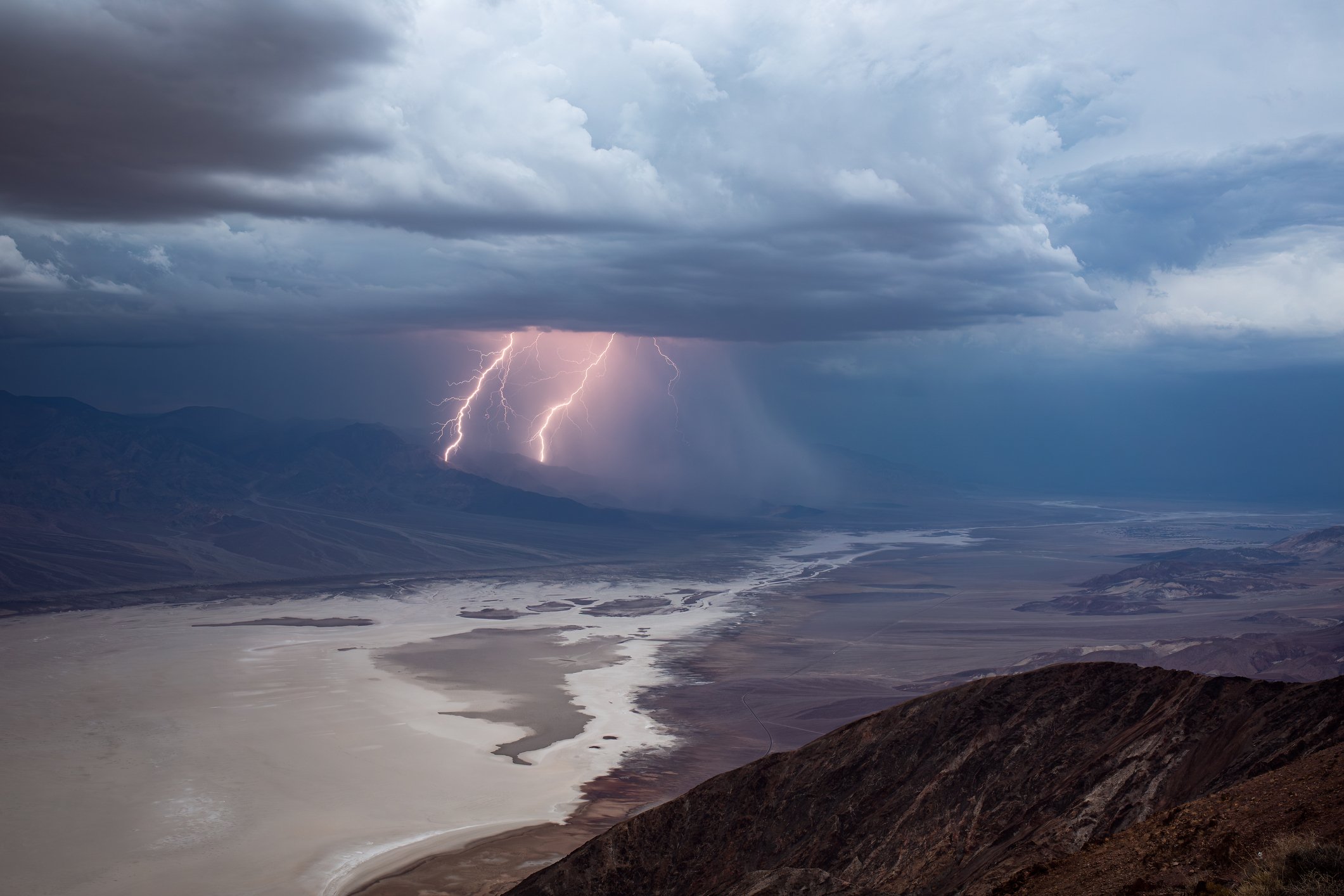
Thunder’s sound and intensity can depend on several factors. “Terrain is one thing,” says Belles. For instance, think of how a voice echoes when it’s in a cave or a canyon, bouncing off of the hard rock walls. If you get thunder in a valley, it can behave the same way. The valley’s steep topography acts as an acoustic funnel, collecting sound waves over a large area and concentrating them into a smaller, directed point.
“If there’s a mountain or a reflective surface on the other end, the thunder’s echoes can go back and forth for a bit.” This creates what’s known as “rolling thunder,” a continuous, low-frequency rumble that often drags out over a few seconds.
Temperature can also play a role in amplifying thunder, especially during an atmospheric (or temperature) inversion. This is a meteorological phenomenon where a layer of warmer air sits on top of a layer of cooler, denser air and traps that cooler air close to the ground.
“It’s like creating an artificial barrier above your head,” says Belles. The warm layer also traps in sound waves, causing them to bounce repeatedly between the ground and the warm layer, resulting in a megaphone-like effect.
During an atmospheric inversion, says Belles, thunder will bounce up and down in the cold, dense air until it disperses. Think of it like setting off a firework inside of a long, narrow hallway (which, by the way, is a really bad idea). The sound becomes trapped and amplified.
At what distance is thunder audible?
Thunder is typically audible 10 to 15 miles away, says Belles. However, it’s possible to hear it up to 25 miles away under ideal atmospheric conditions—such as in a flat, quiet, or temperature-inverted environment.
Lightning, on the other hand, generally travels three or four times farther visually than the sound of thunder does. Lightning can sometimes be seen from over 100 miles away at night, with the flash reaching your eyes in a fraction of a second.
Instead, the sound waves from thunder lose their energy much more quickly, causing them to die out faster the further they travel.
You can’t have thunder without lightning, notes Belles. “If you hear thunder but don’t see lightning, there’s typically something blocking your view.” Maybe it’s thick clouds or even the curvature of the earth.
“Summer is a prime time for ‘heat lightning,’ which is a nickname for the faint lightning flashes that can appear along the horizon on warm, humid nights. “It’s not any kind of awesome phenomenon. It’s just that the lightning is far enough away that you can’t hear the thunder.”
What are the different types of thunder?
“There aren’t really different kinds of thunder,” says Belles, “but there are many different types of lightning,” which can affect the way thunder sounds.
For example, “there’s something called positive lightning strikes.” These lightning bolts originate from the upper regions of a thunderstorm cloud instead of its base. Though relatively rare, these intense lightning strikes have up to 10 times more electrical energy than typical strikes. “Because they carry enough energy to travel, say, 50,000 feet to the ground, the thunder that accompanies them will often be a lot louder.”
There are also thunderclaps, which are loud, explosive sounds of thunder that can accompany an extremely close lightning strike. It’s basically thunder that hits your ears before it’s had time to reverberate and echo.
Or you might hear thunder as a prolonged, low-frequency rumble. This often occurs when the lightning strikes are a few miles away. As the sound waves from the lightning’s resulting thunder travel, the atmosphere naturally absorbs their sharper, higher-pitched frequencies. What remains are thunder’s deep, bass-heavy tones.
Ultimately, the louder the thunder, the closer the storm. The National Weather Service warns that if you hear thunder at all, you are generally within striking distance of the storm. This means that lightning can strike anywhere around you (even if it’s sunny), so it’s best to hunker down indoors.
In Ask Us Anything, Popular Science answers your most outlandish, mind-burning questions, from the everyday things you’ve always wondered to the bizarre things you never thought to ask. Have something you’ve always wanted to know? Ask us.
Related 'Ask Us Anything' Stories
The post Why is thunder so dang loud? appeared first on Popular Science.
from Popular Science https://ift.tt/YfpAnu1




0 Comments