
Solid State Logic built its name on mixing consoles that cost more than most houses and fill half a room. The SSL 1 is a two-input box that runs off a phone charger and sells for $159.99. I set one up over a couple of weeks, then handed it off to a producer and professor (who shall remain nameless due to his contractual brand affiliations), because the verdict that matters on gear like this comes from someone who leans on it every day. His short take: it does exactly what it promises, as long as you know going in what it isn’t.
If you’re new to this, an audio interface is the box that sits between your microphone or instrument and your computer. It converts the analog signal into clean digital audio your recording software can use, supplies the power a condenser mic needs, and drives your headphones without the lag you’d get plugging straight into a laptop. The SSL 1 handles that job with two inputs, one for a mic and one for a guitar, bass, or synth, and it does it over a single USB-C cable.
Don’t mistake it for a shrunken SSL 2+. SSL stripped this one down on purpose, aiming at one person and a mic, or one person and a guitar, and it makes reasonable tradeoffs to hit its price and size. If those tradeoffs line up with how you work, it’s an easy recommendation.
Solid State Logic SSL 1 audio interface review: A pro studio sound for $159
See It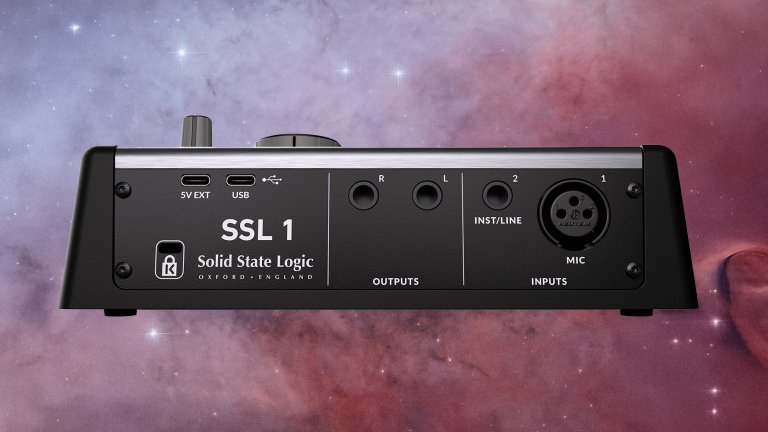
Two inputs, one preamp
The SSL 1 is a 2-in/2-out USB-C interface with 32-bit/192 kHz converters. Channel 1 is an XLR mic input with +48V phantom power, a high-pass filter, and SSL’s Legacy 4K enhancement. Channel 2 is a single 1/4-inch input that switches between instrument (DI) and line level. That’s it. One mic, one instrument, at the same time.
The mic channel uses the same preamp design SSL runs across its pricier 2+, 12, and 18 interfaces, and the knobs use the same potentiometers and caps as the high-end hardware. You’re paying for the front end, not the feature list. The thing to notice before you buy is what the layout can’t do: there’s no second mic input, no MIDI, no stereo pair for a keyboard’s left/right outputs. Plug a synth in and you get one channel unless you split it.
Out of the box
The form factor is the best thing here. The SSL 1 uses the same wedge shape as the rest of the SSL desktop line, shrunk down to something that disappears next to a laptop. It feels like a real piece of SSL gear rather than a budget afterthought. The knobs have weight and a smooth turn, and the chassis doesn’t creak or flex when you pick it up.
Almost everything lives on the back: the two balanced TRS outputs, both USB-C ports, and the XLR and instrument jacks. Only the headphone output sits up front. That keeps the top panel clean, but it means the instrument input is behind the unit, so plugging a guitar in and out is a reach-around rather than a front-panel grab. If you swap instruments constantly, that placement will annoy you. The two USB-C ports split duties: one carries data and bus power, the second takes 5V from a phone charger or battery when your host device can’t feed enough power on its own.
In the studio
Handing the SSL 1 to a working producer who teaches recording at a local college was the useful part of this test, and his read was consistent with what I heard on the plug-and-play side. The mic preamp is clean and quiet, with enough gain to drive a vocal or an acoustic without hunting for the top of the dial. He tracked vocals and a DI’d electric through it and came away impressed that the front end matches what SSL puts in interfaces costing two and three times as much.
Legacy 4K is the marquee feature, and it does what SSL says without doing more than it claims. It’s an analog circuit that emulates the company’s 4000-series console sound by adding a high-frequency lift and a touch of harmonic grit. On vocals it adds air and helps them sit forward. On a DI guitar it adds a little definition. The effect is a seasoning rather than a rebuild, and it only lives on the mic channel, so you can’t hit an instrument on channel 2 with it unless you route through a DI box into the mic input.
Two things stood out to him as the real reasons to pick this over a generic budget box. The first is that it runs on an iPad. It’s USB Audio Class 2.0 compliant, so it works with iOS and iPadOS with no drivers, and the external 5V port means you can power it off a battery instead of draining the tablet. For a mobile setup or a coffee-shop writing session, that combination is the point. The second is the 32-bit converters, which he did not expect to see at this size and price and which give you a lot of headroom to record into without clipping.
Setup is as simple as SSL claims. On Mac and iOS it’s plug-and-play; on Windows you install a driver and you’re recording. Monitoring is where the simplification shows: instead of a blend knob, you get a Mix button that flips between your live input and your DAW playback at a fixed 50/50. It keeps costs down and it’s dead easy to understand, but you can’t dial in a custom balance from the hardware. You lean on your DAW’s master fader instead. There are also three stereo loopback channels for pulling computer audio into a stream, which is the nod to podcasters and streamers.
Who should buy it
The SSL 1 is built for the singer-songwriter, the podcaster, the streamer, and the mobile producer who records one or two sources at a time and wants SSL’s preamp without SSL’s bulk. If you record on an iPad or want a box you can throw in a bag, it’s close to ideal. It also earns a spot for a beginner who’d rather grow into a serious front end than replace a toy interface in a year.
Skip it if you track more than one mic at once, need MIDI, or record stereo line sources like a keyboard or a hardware synth’s main outputs. Those buyers should step up to the SSL 2+ MKII, which adds the second mic preamp, MIDI, and the routing flexibility the SSL 1 leaves out.
The verdict
Buy the SSL 1 if you record one source at a time and want a portable interface with a preamp that punches well above $159.99. It nails the form factor, the iPad support and 32-bit converters are rare at this size, and the front end is the real SSL, not a watered-down version. The catches are the single mic input, the rear-mounted instrument jack, and the fixed 50/50 monitor mix. None of those are dealbreakers for the person this is built for. Know what you’re buying and the SSL 1 delivers exactly that, which is more than most gear at this price manages.
The post Solid State Logic SSL 1 audio interface review: A pro studio sound for $159 appeared first on Popular Science.
from Popular Science https://ift.tt/M6gQUEd




0 Comments