
Today, we celebrate the United States’ semiquincentennial, marking 250 years since the signing of the Declaration of Independence. During reflective national moments like these, we tend to focus on the political ambitions and accomplishments of our nation’s founders and those that followed. However, American independence was not won through perseverance and politics alone. Many of our nation’s founders were also practitioners of “natural philosophy” or what we call science today.
“America is America because of our prowess in science and innovation,” Darryl Williams, Senior Vice President of Science Education at the Franklin Institute in Philadelphia, tells Popular Science. “Benajamin Franklin [along with our other founders] saw the opportunity for this new nation to really have as part of its fabric this focus on science to enhance and improve the human condition.”
The need to create a distinct intellectual identity was not just appealing for the nation’s founders, but undoubtedly crucial for independence from England.
“I think the economic piece of it is really critical. The very practical need to assert economic independence from England really drove a lot of the early conversations,” Adrianna Link, Curator of History of Science at the American Philosophical Society in Philadelphia, tells Popular Science. “Questions like how could we increase crop efficiency or deal with agricultural pests [including the Hessian fly] were fundamental to our survival.”
Whether a purely intellectual or economic pursuit, science was not only fundamental to our independence and ability to thrive as a nation in 1776, but remains so in 2026.
Ben Franklin with a key and a kite (and much more)
Benjamin Franklin’s contributions to early American science are arguably the most widely known and celebrated. His numerous inventions included the odometer, the lightning rod, the flexible catheter, and bifocals, but Franklin also considered the very act of accumulating knowledge and sharing information to be the noblest of pursuits. In a letter to Sir Joseph Banks dated July 27, 1783, he wrote “I begin to be almost sorry I was born so soon, since I cannot have the happiness of knowing what will be known a hundred years hence.”
To support this effort in the then American colonies, Franklin founded the The American Philosophical Society (APS) in Philadelphia in 1743. Its purpose was simply stated as“promoting useful knowledge.” APS is not only the oldest learned society in the United States, but also the longest continually operating press in the country. APS’s flagship journal Transactions of the American Philosophical Society was first published in 1771 and continues through today.
“Franklin thought a lot about how best to allow people to have access to and share information,” says Williams. Franklin had previously founded the Library Company of Philadelphia in 1731, and donated books from his personal collection to what would become the Franklin Public Library. The library remains the oldest public lending library in the U.S.
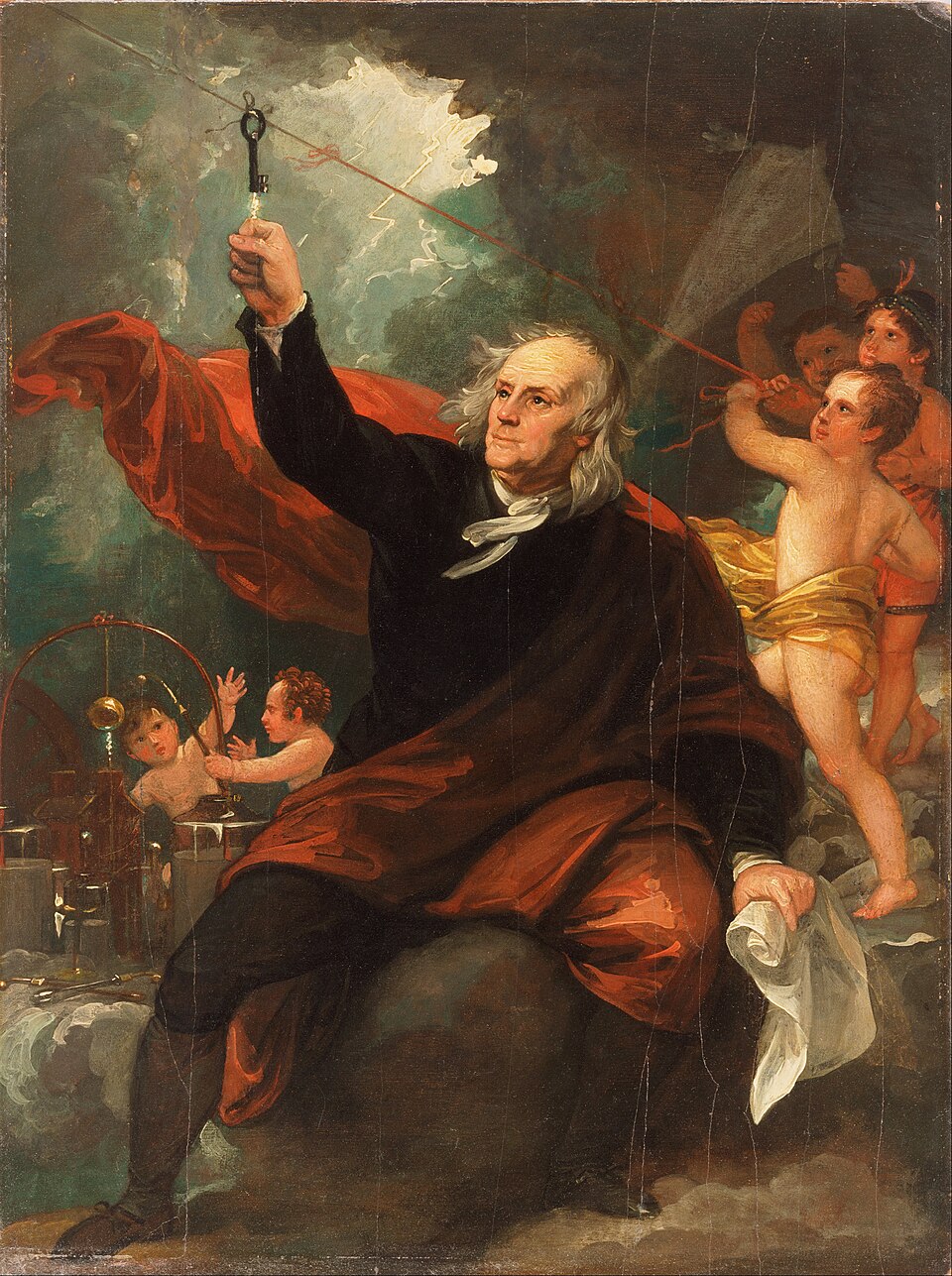
Franklin was also one of our earliest and brightest science communicators. In 1752, he successfully demonstrated the electrical nature of lightning with his famed kite-in-a-thunderstorm experiment. Franklin recounted the event in the Pennsylvania Gazette on October 19, 1752, providing detailed instructions for, “drawing electric fire from clouds by means of pointed rods of iron,” so that others could replicate his experiment. His experiment was reproduced by many including an account published in the Pennsylvania Gazette in July 26, 1753. His findings were also celebrated across Europe.
“Benjamin Franklin had all these incredible inventions that, again, have impacted society even through today, but I think his biggest legacy is really this idea around participatory science,” adds Williams.
David Rittenhouse and the Transit of Venus
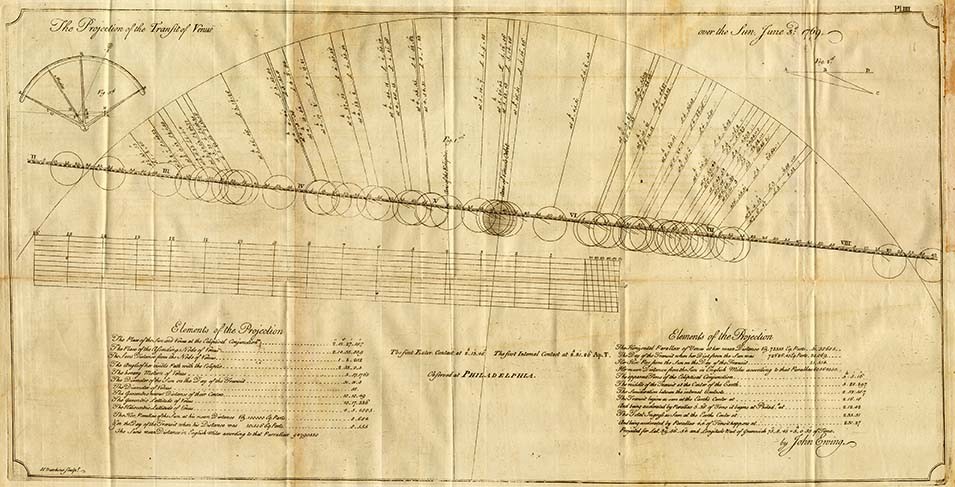
By the 1760’s, the stars and planets literally and figuratively aligned for Franklin’s APS. On June 3, 1769, Venus passed directly between the sun and the Earth, becoming visible against the solar disk. Called the Transit of Venus, the celestial event had also occurred in 1761, but attempts by the global scientific community to directly observe and document it were unsuccessful.
David Rittenhouse, astronomer, surveyor and inventor, joined APS in 1768, and used his skills to lead the American efforts to observe the 1769 Transit of Venus. Armed with his own homemade telescope, his team’s observations and measurements were later published in The Royal Society’s Philosophical Transactions and helped French astronomer Jérôme Lalande accurately determine the precise distance between the Sun and the Earth. That measurement is still used today and called the astronomical unit (AU).
Under Franklin and later Rittenhouse and Thomas Jefferson’s leadership, APS showed how to mobilize a network of well-educated individuals and share their observations and data with counterparts across the colonies and Europe.
“This kind of transatlantic exchange was as much part of the early identity of the APS as was the formation of something that one might think of as distinctly American science,” says Link.“If you think of Franklin as kind of creating the preconditions for America’s scientific success, it’s really Jefferson who establishes that close connection between the APS and the New Republic’s commitment to doing science.”
Magnificent megafauna and America’s first science museums
To further promote and popularize science in the newly formed United States, public-facing natural history museums formed in the later 1700s. Early curators first had to establish and build natural history collections almost completely from scratch, while also improvising and experimenting with how to exhibit the scientific discoveries of the day.
“It was very minimal storytelling [at first]. It was more along the lines of, this is what we have…very curiosity cabinet-style presentation,” Matt Gibson, Curator of Natural History at the Charleston Museum, tells Popular Science.
The Charleston Museum in Charleston, South Carolina, considered America’s First Museum, was founded by the Charleston Library Society at the eve of the American Revolution in 1773. Its early founders and contributors included distinguished South Carolinian Thomas Heyward Jr., a member of the Second Continental Congress and a signer of the Declaration of Independence.
At first, the museum was open only for Charleston’s Elite. After a major fire in 1778 and dwindling funds in the decades that followed, the Library Society transferred all of its collections to the Literary and Philosophical Society of South Carolina in 1815. They opened to the general public in 1824, charging 25 cents for adult admission.
“When they opened, they had some 4,000 minerals [on display], prints and paintings, and numerous natural history specimens,” Jennifer McCormick, Chief Curator at The Charleston Museum, tells Popular Science. “We still have three objects from the [18th century collection] that includes a crested chief’s helmet from the Sandwich Islands (Hawaii), a Cassava strainer, and three spears from Suriname.”
Peale’s Museum opened in Philadelphia in 1784. Its founder Charles Wilson Peale was a painter, Revolutionary War officer, state assemblyman, scientist, and naturalist. His first exhibition was 44 portraits that he painted of early American heroes including Presidents George Washington and Thomas Jefferson. In 1786, his museum began showcasing natural curiosities alongside his portraits. In 1794, Peale accepted the role of APS librarian and moved the museum to their building. Rittenhouse’s famed telescope is among the surviving artifacts at APS.
“One of the things that Peale did very deliberately was thinking about this [connection] between science and American identity. He paired natural history specimens with portraiture. You’d have George Washington’s portrait alongside the mounted mastodon skeleton, which was a huge kind of wonder in the American imagination [at the time],” says Link.
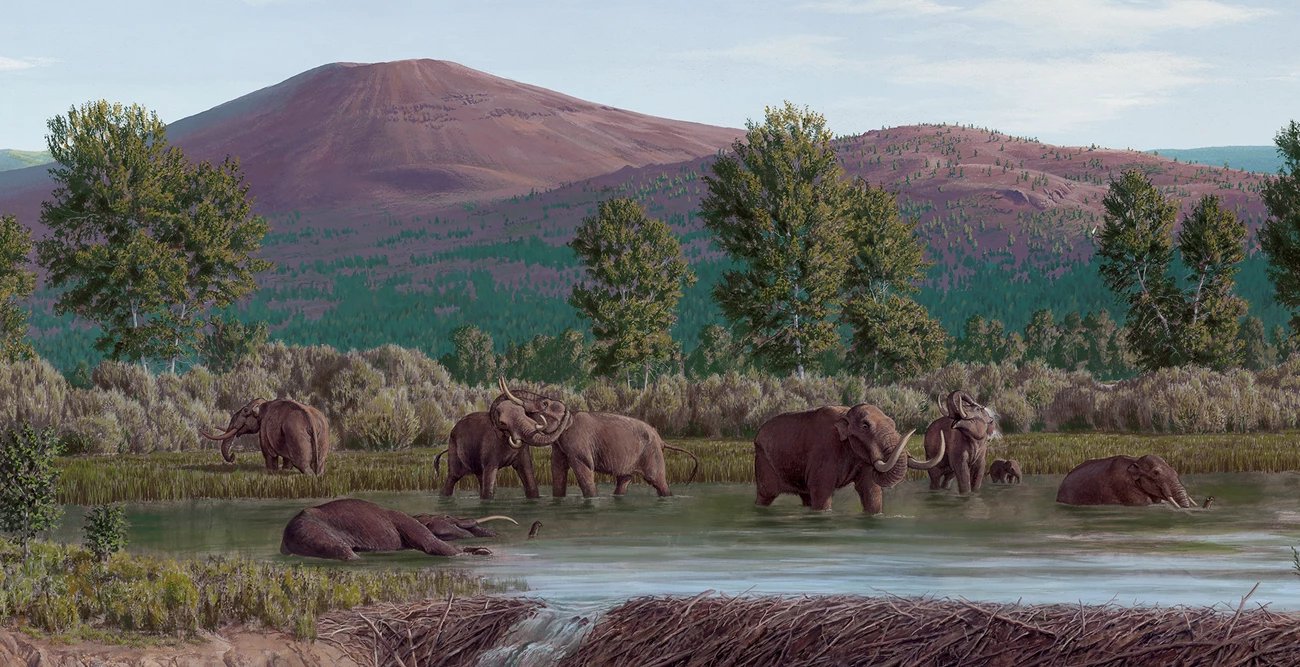
This push to showcase the biggest and fiercest animals that once roamed the continent, was not just about generating business or buzz. It was politically motivated as well. “After the revolution, there was all that conversation about how American flora and fauna were inferior to those found in Europe” says Link. “That’s why the mastodon discovery is such a critical one for [America] and the APS, too because that was an example of America actually having impressive megafauna.”
The Charleston Museum maintained its own impressive collection of extinct American megafauna over the centuries including the estuarine crocodile (Gavialosuchus carolinensis), a giant ground sloth (Eremotherium laurillardi), Jefferson’s ground sloth (Megalonyx jeffersonii), and the false-toothed bird Pelagornis sandersi, a bird species with a wingspan somewhere between 21 to 24 feet.
These early museums and their natural history displays not only captured the public’s imagination, but likely served as inspiration for countless 19th century natural history museums that followed, including The Academy of Natural Sciences of Drexel University in Philadelphia (1812), The Smithsonian Institution in Washington D.C. (1846), and The Field Museum in Chicago (1894).
Us and the state of American science today
Science has come a long way since the American Revolution—thank you, germ theory and vaccines. But the dogged pursuit of knowledge and scientific integrity that was among the earliest preoccupations of our nation’s founders remains vital to the continued success of our science and nation.
Acquiring knowledge and using it to improve our new nation and the lives of its citizens remains something that we experience every day, through the use of weather and crop disease forecasting tools that saves lives, genetic research to improve and personalize medicine, and advanced computing and instrumentation to help decipher the complicated history of our planet and universe.
While 18th Century practitioners of natural philosophy did not need the specialized skills, multimillion dollar instruments or the advanced degrees required of today’s scientists, science, at its very core, is still achieved through careful observation and critical thinking. And that’s something Franklin, Jefferson and other early scientific revolutionaries hoped to instill in every American.
Related Stories
The post The American revolutionaries who popularized science in the early United States appeared first on Popular Science.
from Popular Science https://ift.tt/pizwQnJ





.jpg)
0 Comments