
My gym has a sauna, but it’s gross. It’s also often broken. That’s why a home sauna has started to seem so appealing. The Sun Home Eclipse 2-Person and Eclipse 4-Person saunas represent the current state of home sauna tech: units that combine full-spectrum infrared heating elements with integrated red light therapy (RLT) panels, letting users run either modality independently or both at the same time. That dual approach sets the Eclipse line apart from most infrared saunas on the market, which typically rely on infrared heat alone.
Sun Home Eclipse 2-Person Red Light & Infrared Sauna
See It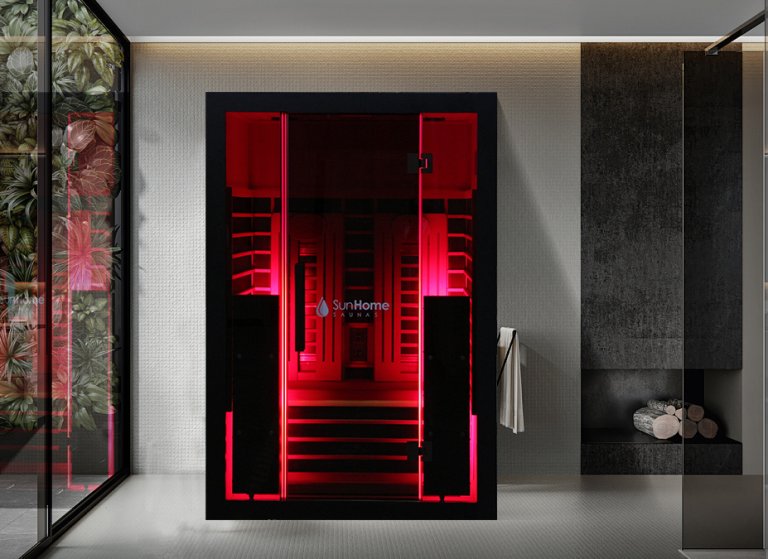
The 2-Person Eclipse is built around six far-infrared heaters covering the walls, calf area, and floor, plus two full-spectrum heaters on the back wall—all running at 500 watts. The unit operates on a standard 120V circuit (NEMA L5-30P, dedicated outlet required) at 2,820W, maxes out at 165°F, and sits at 51.5″ L × 47.2″ D × 76.7″ H with an interior of 42.8″ L × 42.2″ D × 71.5″ H. Construction uses Canadian red cedar, and the company claims EMF emissions of 0.5 milligauss via its patented shielding—below the level of most common household appliances. Assembly uses Sun Home’s tool-free Magne-Seal panel-locking system.
Sun Home Eclipse 4-Person Red Light & Infrared Sauna
See It
The 4-Person model scales up to 12 far-infrared heaters and four full-spectrum heaters, plus two dedicated red light therapy towers mounted to the front of the unit. It requires a 240V dedicated circuit (NEMA L6-30P, 5,300W, 22A) and weighs 925 lbs, with exterior dimensions of 94.4″ L × 55.1″ D × 76.7″ H and a usable interior of 85.7″ L × 50″ D × 76.7″ H. Sun Home recommends leaving 4–6 inches of clearance around the unit and 12–14 inches of clearance above the roof when building it into an enclosed space.
How full-spectrum infrared heating works
Unlike traditional saunas that heat the air around you, infrared saunas use electromagnetic radiation to warm the body directly. As we’ve previously explained, infrared light penetrates the skin without significantly raising ambient air temperature, which means the sauna can operate at lower temperatures while still producing a deep sweat. The term “full-spectrum” refers to the inclusion of near-infrared (roughly 700 to 1,400 nanometers), mid-infrared, and far-infrared (approximately 6 to 14 microns) wavelength ranges, each of which interacts with the body differently.
Far-infrared wavelengths produce the most thermal energy and are the most studied in the context of sauna therapy. A review published in the Canadian Family Physician journal found that far-infrared sauna therapy showed benefits for patients with systolic hypertension and congestive heart failure, though the authors noted the evidence base remains limited and called for larger trials. A separate systematic review and meta-analysis of seven studies involving 491 heart failure patients found that infrared sauna therapy was associated with short-term improvements in cardiac function. The Mayo Clinic notes that while several studies have examined infrared saunas for conditions including high blood pressure, heart failure, and chronic pain, most of this research has been small in scale and more rigorous evidence is still needed.
What the red light therapy panels do
The more distinctive feature of the Eclipse line is its integrated red light therapy panels, which deliver wavelengths in the 630 to 850 nanometer range. This technology—formally known as photobiomodulation—is distinct from infrared sauna heat. It uses specific, narrower bands of visible red and near-infrared light at measured irradiance levels rather than broad-spectrum thermal energy. Red light at 630–670 nm targets surface and mid-depth tissues, penetrating roughly 8 to 10 mm into the skin, while near-infrared light at 810–880 nm reaches deeper into muscle, joints, and connective tissue.
The proposed cellular mechanism involves stimulation of cytochrome c oxidase in the mitochondrial electron transport chain, which may increase ATP production. A review published in the Aesthetic Surgery Journal covering photobiomodulation’s clinical applications found over 4,000 studies indexed in PubMed, though the authors noted that the commercial market has outpaced the clinical evidence base. A separate controlled trial in Photomedicine and Laser Surgery found that red and near-infrared light increased intradermal collagen density, with subjects reporting improvements in skin complexion and texture. As our own reporting notes, experts caution that the direct correlation between infrared energy and mitochondrial stimulation is not yet firmly established across all claimed applications, but the research is growing all the time.
EMF, materials, and safety
Electromagnetic field (EMF) exposure is a common concern with infrared saunas. The Eclipse models feature what Sun Home describes as patented EMF and ELF (extremely low frequency) shielding, with claimed readings of 0.5 milligauss—below the levels produced by many household appliances. The construction uses low-VOC, non-toxic materials throughout. Both models use Canadian red cedar, a naturally antimicrobial wood species.
Additional features
Both Eclipse models include chromotherapy lighting, Bluetooth audio, and connectivity to Sun Home’s mobile app, which handles remote session control and includes a library of guided breathwork courses. Benches in both models are removable to open floor space for stretching or yoga. Sun Home notes that the Eclipse saunas are HSA/FSA eligible through Truemed, a third-party service that facilitates health savings account purchases for qualifying wellness products—buyers should verify eligibility with their specific plan before purchasing.
More sauna and red light coverage from PopSci
- Do Infrared Saunas Work? What the Science Says
- The Best Infrared Saunas
- The Best Home Saunas
- The Best Portable Saunas
- The Best Outdoor Saunas
- Do LED Masks Work? What the Science Says
- The Best LED Face Masks
The post Sun Home’s Eclipse Red Light & Infrared Saunas blend two popular sauna technologies into a model meant for the home appeared first on Popular Science.
from Popular Science https://ift.tt/oWNXPy3


0 Comments