
Home saunas have moved well beyond the luxury category. A growing body of peer-reviewed research—including a 2018 review in Mayo Clinic Proceedings and a 2023 follow-up in the same journal—links regular sauna use to reduced cardiovascular risk, lower blood pressure, and decreased all-cause mortality. A 2025 review in Frontiers in Cardiovascular Medicine found that the physiological responses to sauna bathing closely resemble those of moderate aerobic exercise, making it especially relevant for people with limited mobility or those looking to complement an existing fitness routine. Whether you’re drawn to the science or simply want to unwind after a long day, the best home saunas—like our top pick, the Sun Home Eclipse 2-Person Red Light & Infrared Sauna—make it possible to build a consistent habit without a gym membership or spa visit.
Home saunas generally use one of two heating methods. Traditional steam saunas heat the air around you—often to 150–200 degrees Fahrenheit—using a heater and sometimes water poured over hot rocks. Infrared saunas, by contrast, use electromagnetic wavelengths to warm your body directly at lower ambient temperatures, typically between 120 and 165 degrees. As PopSci has reported, a 2021 meta-analysis found that heat therapy can reduce blood pressure and improve vascular function, while smaller studies have shown infrared heat may help with post-workout muscle soreness and short-term relief from rheumatoid arthritis symptoms. Some newer models also incorporate red light therapy and full-spectrum infrared (near, mid, and far wavelengths), which adds another dimension to the wellness equation. No matter which type you prefer, understanding the differences will help you choose the right model—which is why we’ve done the legwork to find the best options available today.
- Best overall: Sun Home Eclipse 2-Person Red Light & Infrared Sauna
- Best for indoors: SereneLife Full Size Portable Steam Sauna
- Best 2-person: Dynamic Andora Low EMF Far Infrared Sauna
- Best outdoor: Sunray 3-Person Outdoor Sauna
- Best budget: Durasage Oversized Portable Steam Sauna
How we chose the best home saunas
We evaluated dozens of home saunas across a range of price points, heating technologies, and form factors. Our selections include premium full-spectrum infrared cabins for dedicated wellness spaces, mid-range infrared units that balance features with value, and portable steam options that fold down for apartment living or small homes. We weighed heating performance, build materials, EMF levels (for infrared models), ease of assembly, warranty coverage, and real-world user feedback. We also consulted independent reviews and PopSci’s infrared sauna coverage to cross-reference our findings. Every pick on this list is currently available for purchase and backed by a manufacturer warranty.
The best home saunas: Reviews & Recommendations
The health case for regular sauna use continues to strengthen. A landmark Finnish study published in JAMA Internal Medicine found that men who used a sauna four to seven times per week had significantly lower rates of sudden cardiac death, coronary heart disease, and all-cause mortality compared to those who bathed once a week. More recently, a 2023 review in Mayo Clinic Proceedings noted that for people who can’t meet standard physical activity guidelines, regular sauna use may serve as an alternative lifestyle strategy to help reduce disease risk. Beyond the research, there’s something to be said for having a dedicated recovery space in your own home. So fill up that water bottle, hydrate well, and get ready to sweat.
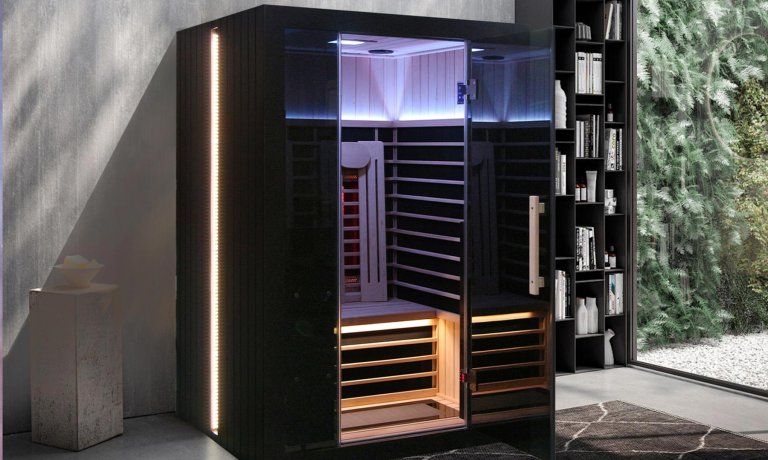
Best overall: Sun Home Eclipse 2-Person Red Light & Infrared Sauna
Pros
- Full-spectrum infrared with near, mid, and far wavelengths
- Integrated red light therapy towers
- Mobile app control and Bluetooth surround sound
Cons
- Requires a dedicated NEMA L5-30P outlet
- Premium price point
Specs
- Exterior Dimensions: 51.5 x 47.2 x 76.7 inches
- Weight: 600 pounds
- Materials: Canadian Red Cedar
Why it made the cut: This full-spectrum infrared sauna pairs advanced heating technology with integrated red light therapy and smart controls, representing the current state of the art for home infrared saunas.
The Sun Home Eclipse 2-Person delivers full-spectrum infrared heat across near, mid, and far wavelengths—an approach that targets different tissue depths. It uses eight total heaters: six far infrared panels (distributed across the left wall, right wall, calves area, and floor) and two full-spectrum panels on the back wall. The unit reaches a maximum temperature of 165 degrees Fahrenheit, which is notably higher than many competing infrared models that top out around 140 degrees. That higher ceiling matters because it gives you a wider therapeutic range to work with, whether you prefer a gentler session around 130 degrees or a more intense experience closer to the max.
What sets the Eclipse apart from older infrared cabins is its integrated red light therapy towers. Red light therapy (also called photobiomodulation) uses specific wavelengths of light that have shown promise in studies for reducing inflammation and supporting skin health. Having it built into the sauna means you can combine two wellness modalities in a single session rather than needing separate devices. The sauna also features medical-grade chromotherapy lighting, a Bluetooth surround sound system, and a mobile app that lets you preheat the unit, set timers, and access guided breathwork sessions from your phone.
Construction is Canadian Red Cedar, a naturally rot-resistant and aromatic wood that handles repeated heat and moisture cycles well. At 600 pounds and requiring a dedicated NEMA L5-30P outlet (120V/2820W), this is a sauna that needs a permanent home—a basement corner, garage, or spare room works best. Sun Home recommends 4–6 inches of clearance around the unit for airflow. It’s a significant investment at $10,599, but for those committed to daily or near-daily sauna use, the build quality and feature set justify the price. Sun Home also makes a 4-person version of the Eclipse ($13,599) with 12 far infrared heaters, four full-spectrum heaters, removable benches for in-sauna yoga or stretching, and a 240V electrical requirement for those who want more room.
Best for portable: SereneLife Full Size Portable Steam Sauna

Pros
- Easy access, full-sized design
- Fully collapsible for easy storage
- Energy-efficient
Cons
- Not tall enough to fully stand up
- No internal zipper
Specs
- Dimensions: 35.4 x 35.4 x 70.9 inches
- Weight: 27.8 pounds
- Materials: Cloth, plastic
Why it made the cut: This large-capacity, full-size portable sauna collapses for closet storage and offers a genuine full-body steam experience without requiring any permanent installation.
Unlike most portable saunas that require you to sit on a chair with your head poking through a hole, the SereneLife Full Size Portable Steam Sauna is tall enough (just under 71 inches) to let you sit comfortably with your entire body enclosed. It includes a small viewing window and hand-access zippers so you can use your phone or read while you sweat. When you’re done, the whole unit folds down flat for closet storage—making it one of the few saunas genuinely suited to apartment living.
The 1,600-watt heating element paired with a 4-liter steamer reaches the unit’s maximum temperature of 122 degrees Fahrenheit fairly quickly. That temperature is modest compared to wooden infrared cabins, but it’s typical for portable steam models—and research suggests that even moderate heat exposure can provide cardiovascular benefits when used consistently. A wired remote control lets you adjust among nine heat levels and set a timer up to 60 minutes from inside or outside the unit.
The main compromise is ergonomics: taller users may find it difficult to stand up and exit, and there’s no way to open the zipper from the inside. There’s also no on/off switch—you plug it in to start and unplug it to stop. These are small inconveniences weighed against the price (typically under $200) and the fact that it genuinely works. For those who want a sit-down portable sauna with a head opening instead, check out our portable sauna picks.
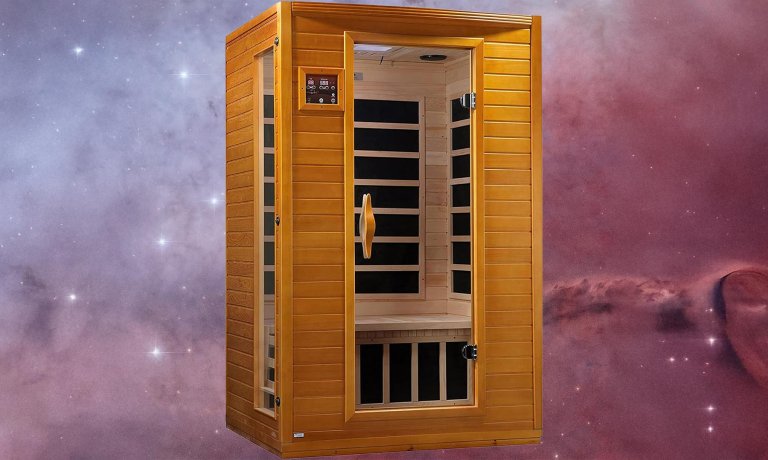
Best 2-person: Dynamic Andora Low EMF Far Infrared Sauna
Pros
- Control panel with LED display
- Tempered glass door and side windows
- Assembles in about an hour
Cons
- Max temperature of 135°F is lower than some competitors
- Small gap at the bottom of the glass door
Specs
- Dimensions: 47 x 43.1 x 74.4 inches
- Weight: 319 lbs.
- Materials: Natural reforested Canadian hemlock wood
Why it made the cut: A well-built two-person infrared cabin with easy assembly, a handsome tempered glass design, and a price that undercuts many competitors.
The Dynamic Andora is a solid mid-range infrared sauna that comfortably seats two adults. It assembles in about an hour—panels click together with a buckle system—and plugs into any standard 15-amp, 120-volt outlet, so there’s no electrician visit required. The cabin is built from reforested Canadian hemlock with double-paneled walls, which improves heat retention and energy efficiency compared to single-wall designs.
Inside, six low-EMF carbon PureTech far infrared panels provide even heat distribution. The Andora tops out at 135 degrees Fahrenheit—lower than some competing models, but Golden Designs (the manufacturer) recommends a comfort range of 115–130 degrees for most users. If you’re used to traditional steam saunas that hit 180-plus degrees, know that infrared saunas work at lower temperatures by design: they warm your body directly rather than heating the air, so you’ll still sweat heavily even at what might seem like a modest number on the thermostat.
Creature comforts include Bluetooth and aux audio input with built-in speakers, chromotherapy (colored LED) lighting with an optional white reading light, a tempered glass door with side windows, a towel rack, and a magazine holder. The 5-year limited warranty from Golden Designs covers wood, structure, heating elements, and electronics. The main drawback is a small gap at the bottom of the glass door that lets some heat escape—a common issue in this price range, and one that doesn’t dramatically affect performance but is worth noting.
Best outdoor: Sunray 3-Person Outdoor Sauna

Pros
- 7-year structural warranty
- Fits three people comfortably
- Durable weatherproof construction
- Heats up in under 15 minutes
- Bluetooth speakers and interior lighting
Cons
- Ceramic heaters produce less infrared output than carbon panels
Specs
- Dimensions: 69 x 47 x 83 inches
- Materials: Canadian hemlock with sealed waterproof finish
- Type of Heat: Far infrared (ceramic heaters, 2100W)
Why it made the cut: A weatherproof, three-person far infrared sauna with fast heat-up times, Bluetooth audio, and one of the best structural warranties in its class.
Your backyard counts as part of your home, and the SunRay Grandby (model HL300D) is built specifically for outdoor placement. Constructed from Canadian hemlock with a sealed waterproof finish and a shingled roof, it’s designed to handle rain, humidity, and temperature swings without warping or deteriorating. The unit runs on a standard 110V outlet (2,100 watts total) and uses eight ceramic far infrared heaters that bring it to operating temperature—up to 140 degrees Fahrenheit—in about 15 minutes.
Ceramic heaters heat up faster than carbon panels but cover less surface area, which means you may notice slightly uneven heat distribution if you’re sitting far from a heater. That said, in a three-person cabin this compact (69 x 47 x 83 inches), the difference is minor. The Grandby includes deep bench seating on both sides, recessed interior lighting, an exterior control panel, cup holders, and a Bluetooth speaker system. It even has an ozone sterilization system built in, which helps keep the interior fresh between sessions.
Assembly involves screwing and latching pre-cut panels together—plan on about an hour—and the shipping crate fits through any doorway 24 inches or wider. At under $3,000, it’s less expensive than many outdoor infrared competitors, and SunRay backs it with a 7-year structural warranty. That’s a notable commitment for an outdoor product constantly exposed to the elements.
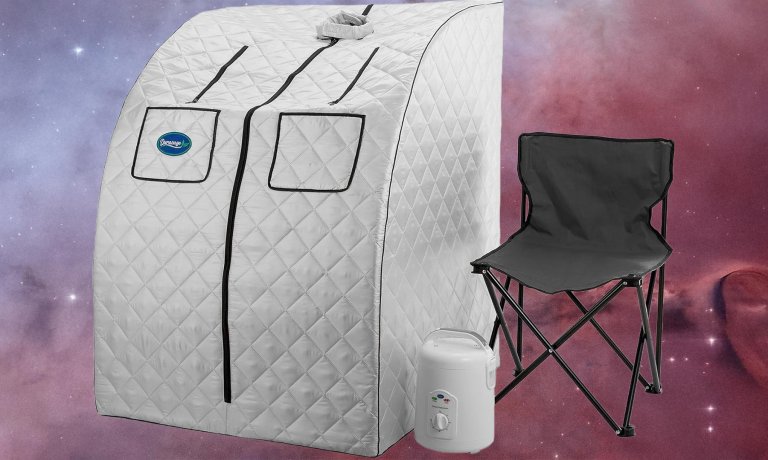
Best budget: Durasage Oversized Portable Steam Sauna
Pros
- Dual pockets and zippered openings
- Roomier than most portable saunas
- Complete kit with chair and steam generator
Cons
- Takes about 15 minutes to produce steam
- Steam generator hose is short
Specs
- Dimensions: 33 x 31.5 x 41 inches
- Weight: 15.72 pounds
- Materials: Polyester, PVC
Why it made the cut: A complete steam sauna kit—tent, chair, and generator—for well under $200, with a roomier design than most portable competitors.
The Durasage Oversized Portable Steam Sauna is the easiest way to test whether regular sauna use works for you without a significant financial commitment. The kit includes the sauna tent, a folding chair, and an 800-watt steam generator with a 1.8-liter ceramic-heated reservoir. Dual front pockets and two zippered hand openings let you read, scroll, or hold a drink while you sweat—a thoughtful design detail that cheaper competitors often skip.
At 33 x 31.5 x 41 inches, the Durasage is slightly larger than most portable sauna tents, which translates to a less claustrophobic experience. You can even drape a towel over the head opening and sit on the floor for a fully enclosed session. The steam generator heats water up to 212 degrees Fahrenheit, which produces an internal temperature of roughly 110–115 degrees. It takes about 15 minutes to start generating steam from a cold start, so factor that into your session planning. Once it’s going, users consistently report even, steady heat.
The main limitation is the steam hose length—it’s a bit short, which means the generator sits directly behind the tent rather than off to the side. The entire unit weighs under 16 pounds with a detachable frame, so breaking it down and storing it in a closet takes about five minutes. For anyone curious about the benefits of portable saunas but hesitant to spend thousands, this is the entry point.
Things to consider before buying the best home saunas
Choosing a home sauna involves more than just picking a price point. Here are the factors that will have the biggest impact on your satisfaction with the purchase.
Size and placement
Measure your intended space before you shop. Full-sized infrared cabins like the Sun Home Eclipse (roughly 51.5 x 47.2 inches for the 2-person, and nearly 8 feet long for the 4-person) need a dedicated footprint plus 4–6 inches of clearance on all sides for proper ventilation. They also weigh 600–925 pounds, so floor strength matters—a concrete basement or garage slab is ideal. Portable steam models, by contrast, fold into a closet and weigh under 30 pounds. If you live in a small apartment, a collapsible steam tent is almost certainly your best bet. If you have a garage, basement, or spare room with a suitable electrical outlet, a permanent cabin delivers a meaningfully better experience.
Materials
Most premium sauna cabins use one of two wood species: Canadian hemlock or Canadian Red Cedar. Hemlock is lighter in color, affordable, and durable, making it the most common choice in the mid-range market. Red Cedar is naturally aromatic, more resistant to moisture and decay, and tends to appear in higher-end models. Both handle repeated heat cycles well. For portable steam saunas, the tent material is typically a multilayer fabric (polyester or nylon with PVC lining) designed to trap steam and resist moisture soaking through. Some manufacturers also emphasize low-VOC (volatile organic compound) and non-toxic construction—worth looking for if you plan to use your sauna daily, since you’ll be breathing in a warm, enclosed space.
Heating method: steam vs. infrared vs. full-spectrum
Traditional steam saunas heat the air to high temperatures (typically 150–200°F), creating an intensely hot, humid environment. Infrared saunas operate at lower ambient temperatures (usually 120–165°F) but use electromagnetic wavelengths to warm your body directly—so you’ll sweat just as much, if not more, at a lower air temperature. Full-spectrum infrared models emit near, mid, and far wavelengths simultaneously, targeting different tissue depths. As PopSci has explored, the science on infrared saunas is promising but still evolving: a 2021 meta-analysis linked heat therapy to reduced blood pressure and improved vascular function, while smaller studies suggest benefits for muscle recovery and joint pain, though researchers note more data is needed.
EMF levels
All electrical devices produce electromagnetic fields (EMF), but it’s a particular consideration with infrared saunas because you sit in close proximity to the heating elements for extended periods. Many current models advertise “low EMF” or “ultra-low EMF” ratings, typically meaning readings under 3 milligauss at seating distance. For reference, the World Health Organization notes that everyday exposure to low-level EMF has not been shown to cause health effects, but some users prefer to minimize exposure as a precaution. If this matters to you, look for manufacturers who publish independent EMF testing results rather than relying solely on marketing claims.
Electrical requirements
Most portable steam saunas and single-person infrared models plug into a standard 120V/15A household outlet. Larger infrared cabins may require a dedicated 120V/20A or 30A circuit—the Sun Home Eclipse 2-Person, for example, draws 23.5 amps at 120V. The 4-person Eclipse requires 240V service and a dedicated outlet, which typically means hiring an electrician. Always check the electrical specifications before purchasing and confirm that your intended location has (or can accommodate) the necessary outlet.
FAQs
Home saunas span a wide price range. Portable steam tents start around $75–$200 and include everything you need to get started. Mid-range infrared cabins with wood construction, low-EMF heaters, and features like Bluetooth audio typically run $1,500–$3,000. Premium full-spectrum infrared models with red light therapy and smart controls range from $5,000 to $14,000 or more. Custom-installed saunas—where a contractor builds the unit into your home—can cost $3,000–$10,000+ for parts and labor, depending on size and complexity.
Operating costs depend on the type and how often you use it. A portable steam sauna drawing 800–1,600 watts for a 30-minute session costs roughly $0.05–$0.15 in electricity at average U.S. rates. An infrared cabin drawing 1,500–3,000 watts for 45 minutes typically costs $0.10–$0.30 per session. Infrared saunas are generally more efficient than traditional steam because they heat your body directly and require less warm-up time—most reach operating temperature in 15–20 minutes compared to 30–60 minutes for steam. Over a month of daily use, expect $3–$10 on your electric bill for most home models.
Sauna use is generally considered safe for most healthy adults, but there are risks to be aware of. The most common side effects include dehydration, dizziness, and light-headedness—all of which are mitigated by drinking water before, during, and after your session. People with low blood pressure (hypotension), certain heart conditions, or who are pregnant should consult a doctor before using a sauna. A 2018 review in Mayo Clinic Proceedings noted that serious adverse events are rare in the research literature, but it’s always a good rule of thumb to talk to your physician before starting any new heat-based wellness regimen—especially if you take medications that affect blood pressure or heart rate.
Traditional steam saunas heat the air in the cabin to 150–200°F, typically using an electric heater or wood-burning stove, sometimes with water poured over hot rocks to create humidity. Infrared saunas use electromagnetic wavelengths to warm your body directly at lower ambient temperatures (usually 120–165°F). Because infrared heat doesn’t need to warm the surrounding air first, these units heat up faster and use less electricity. Full-spectrum infrared saunas emit near, mid, and far infrared wavelengths that target different tissue depths. Both types will make you sweat; the experience just feels different. Traditional saunas feel hotter and more humid, while infrared sessions feel like a gentler, dry heat that builds over time.
A growing body of peer-reviewed research supports several health benefits of regular sauna use. A landmark prospective study published in JAMA Internal Medicine found that frequent sauna users (4–7 sessions per week) had significantly lower rates of cardiovascular disease and all-cause mortality. Reviews published in Mayo Clinic Proceedings in 2018 and 2023 link regular sauna bathing to reduced blood pressure, lower inflammation markers, and decreased risk of conditions including hypertension, dementia, and respiratory disease. A 2025 review in Frontiers in Cardiovascular Medicine noted that the physiological responses to sauna bathing resemble those of moderate aerobic exercise. That said, most of the large-scale evidence comes from traditional Finnish saunas, and research specifically on infrared models—while promising—is still limited. Always consult your doctor before beginning a sauna routine, especially if you have cardiovascular or blood pressure concerns.
Final thoughts on finding the best home saunas
- Best overall: Sun Home Eclipse 2-Person Red Light & Infrared Sauna
- Best portable: SereneLife Full Size Portable Steam Sauna
- Best 2-person: Dynamic Andora Low EMF Far Infrared Sauna
- Best outdoor: Sunray 3-Person Outdoor Sauna
- Best budget: Durasage Oversized Portable Steam Sauna
Our pick for the best overall home sauna is the Sun Home Eclipse 2-Person Red Light & Infrared Sauna. It combines full-spectrum infrared heating, integrated red light therapy, and smart app control in a well-built Canadian Red Cedar cabin—representing the current leading edge of home sauna technology. For those who want more space, the 4-person Eclipse scales up the same platform with removable benches and additional heaters.
If your budget or living situation doesn’t allow for a permanent sauna installation, the Durasage Oversized Portable Steam Sauna delivers on the core promise—consistent, sweat-inducing heat—at a fraction of the cost. It folds up in minutes and costs pennies per session to run. Whatever your starting point, the research is clear: building a regular sauna habit is one of the more accessible ways to support cardiovascular health and recovery. The best sauna is the one you’ll actually use.
The post The best home saunas for 2025 appeared first on Popular Science.
from Popular Science https://ift.tt/JyqUEdS


0 Comments