
When it comes to how animals use ultrasound, chances are you immediately think of bats and their amazing echolocation ability. However, researchers have discovered another—arguably much cuter—animal that can also hear ultrasound, with significant implications for its conservation.
Meet the European hedgehog (Erinaceus europaeus), small nocturnal insectivores that turn into a spiny ball of death when they feel threatened. Unfortunately, the mammals are rapidly declining. Researchers estimate that every year, up to one in three hedgehogs from local populations die on roads, she adds.

“I figured it would make a huge positive impact on hedgehog conservation if we could reduce the number of roadkills,” Sophie Rasmussen, hedgehog researcher and conservationist at the University of Oxford, tells Popular Science. “Therefore, I decided to investigate and describe hedgehog hearing, to understand whether it would be possible to design sound repellents targeted specifically at hedgehogs.”
Rasmussen is the lead author of a study published today in the journal Biology Letters. She and her colleagues worked with 20 rehabilitated hedgehogs from wildlife rescue centers in Denmark. They played brief bursts of sounds on a speaker, while small electrodes placed on the mammals recorded electrical signals fired by their auditory brainstem, shooting between their inner ear and brain.
They found that the brainstem fired electrical signals when the sound was across a range of 4-85 kilohertz (kHz), and had a maximum sensitivity of about 40 kHz. One kHz is 1,000 hertz (a unit of measure for sound frequency). Given that ultrasound corresponds to sound waves over 20 kHz, this means that hedgehogs can hear ultrasound sound waves at least up to 85 kHz. Humans can hear around 20 Hz to 20 kHz.
The studied hedgehogs ultimately returned to the wild after undergoing a veterinary exam. Rasmussen and her colleagues also took high-resolution micro-CT scans of a hedgehog that had been euthanized after a serious injury, which led to the creation of an interactive 3D model of the animal’s ear.
The scans and model showed a whole set of traits tuned for ultrasound hearing. Hedgehogs have a stiffer chain of middle ear bones—which contributes to the efficient movement of extremely high-pitched sounds. They also have a small stapes, or a middle-ear bone that attaches the ear bone chain to the cochlea. Stapes that are smaller and lighter can vibrate faster and transmit high-frequency sounds. Finally, they also have a relatively short and compact cochlea, which allows it to process ultrasonic vibrations better.
“To my great joy we found that hedgehogs hear such high-frequency ultrasound that it is way above humans, cats and dogs,” Rasmussen says.
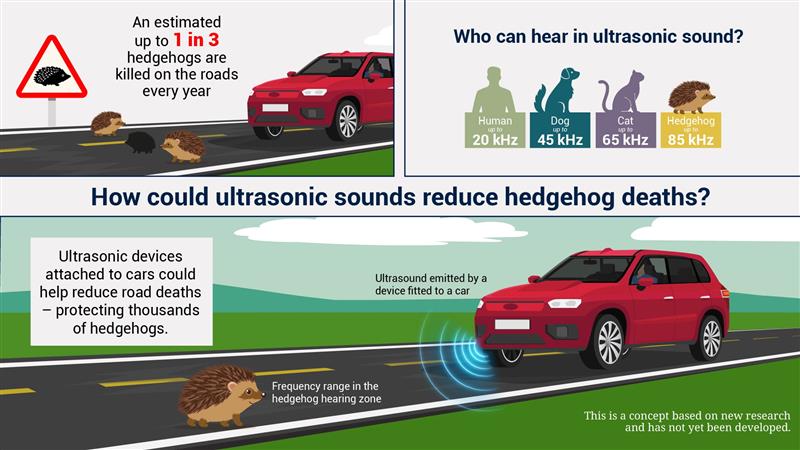
The results are thrilling for Rasmussen, because it opens the door to creating hedgehog sound repellants that keep the mammal away from threats and don’t bother pets, “which makes it much more likely that they will be used.” She explains that, ideally, the repellants would be put in new cars, garden strimmers, and robotic lawn mowers.
“I am really hoping that the car industry will reach out so that we can collaborate on the research to design these sound repellents, which need to be effective and unharmful,” Rasmussen continues. “Because now the real work starts: which sounds to actually deter the hedgehogs? Will the hedgehogs return to the garden/road when the repellents are not playing or will we risk causing harm to hedgehogs?” she muses. “And how often should the sounds change to avoid having the hedgehogs habituate to the sound and start ignoring it?”
On another front, researchers are now curious if hedgehogs communicate with each other or detect prey with ultrasound. Could hedgehogs, like bats, also secure their food by screaming at it?
The post Scientists suggest modifying cars to hit fewer hedgehogs appeared first on Popular Science.
from Popular Science https://ift.tt/gCa0ru5



0 Comments